

NE EDUCATION BUREAU
AHMEDABAD, MAY 12
In a major push towards building a women-led development framework for a future-ready India, Indian Institute of Management Ahmedabad (IIMA), in collaboration with NITI Aayog, the Gates Foundation and the Government of Gujarat, hosted a landmark national workshop on Sustainable Development Goal 5 (Gender Equality), unveiling one of India’s most comprehensive district-level gender equality data initiatives.
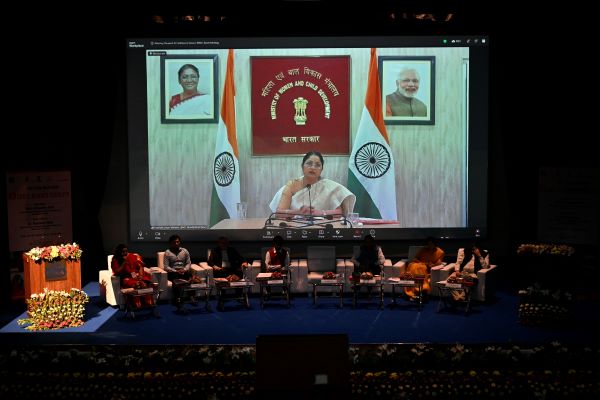
Held at the IIMA campus on May 7, the high-powered NITI-SSM Workshop marked the launch of the SDG 5 State, Union Territories and District Reports, which provide granular insights into gender equality across 792 districts through 26 critical indicators.
- IIMA hosts high-impact SDG-5 workshop with NITI Aayog to accelerate women-led development across India
- Union Minister Annpurna Devi launches groundbreaking gender equality reports covering 792 districts
- Data-driven insights across 26 key indicators to guide policy, budgets and grassroots interventions
- Global agencies including UN, UNICEF, UN Women and World Bank participate in strategic deliberations
- Workshop pushes for tech-enabled governance, real-time monitoring and evidence-based policymaking for Viksit Bharat 2047
Policy experts described the initiative as a transformative step towards shifting India’s governance model from broad welfare approaches to highly targeted, evidence-based interventions designed to accelerate women-led development.
Union Minister Calls for Tech-Driven Gender Governance
The workshop witnessed participation from senior policymakers, global institutions, development experts and international agencies, highlighting the growing importance of data-led governance in achieving India’s long-term development goals.
Annpurna Devi virtually launched the reports and stressed the need for strong data ecosystems, technology-enabled monitoring systems and time-bound evaluation mechanisms to strengthen policymaking.
“In today’s digital era, data has become the cornerstone of policymaking. Technology, artificial intelligence and real-time data systems have made more precise and effective interventions possible,” she said.
The Minister said India, under the leadership of Prime Minister Narendra Modi, was rapidly advancing on the path of “Women-led Development.”
She emphasised that local-level feedback systems, robust implementation ecosystems and dynamic policy evaluations would be critical to achieving the vision of Viksit Bharat 2047.
Massive District-Level Gender Equality Mapping
The newly released reports are expected to become a critical policy tool for governments, institutions and development agencies by offering district-wise insights into women’s health, education, employment, financial inclusion, safety and empowerment indicators.
Experts believe the district-level data mapping will help identify regional disparities, improve targeted resource allocation, monitor policy outcomes and strengthen accountability mechanisms.
The event brought together representatives from global organisations including United Nations, UNDP, UNICEF, UN Women and the World Bank alongside state governments, NGOs and policy specialists.
IIMA Positions Management Education Beyond Corporate Boundaries
Addressing the gathering, Professor Bharat Bhasker said the initiative reflected IIMA’s broader vision of contributing to inclusive national development beyond conventional corporate education.
“The SDG 5 goals are of paramount importance, as women need to be counted as equal partners in our country’s growth journey,” he said.
“Women empowerment doesn’t happen by climbing a ladder; it happens by being the owner of the ladder,” Bhasker remarked, drawing applause from participants.
He also highlighted various entrepreneurship and leadership programmes being run by IIMA for women.
Gujarat Minister Praises Data-Driven Governance
Dr. Manisha Vakil said the district-level evidence-based analysis aligns strongly with Prime Minister Modi’s vision of women-led development.
“Such granular insights will help translate policy into stronger outcomes for women — from local implementation to national impact — through better planning, execution and accountability,” she said.
Meanwhile, Dr. M. Srinivas stressed the importance of replicating successful models nationwide, while Stefan Priesner highlighted the need for locally driven SDG progress to reach women and girls at the grassroots level.
Three High-Impact Panels Drive Action Agenda
The workshop also hosted three major thematic panel discussions focused on:
- Strengthening SDG-5 monitoring through data and evidence-based governance
- Women’s economic empowerment through work, wages and wealth creation
- Community-led and behavioural interventions for social empowerment
Participants stressed that district-level evidence would become central to designing context-specific interventions capable of accelerating gender equality outcomes on the ground.
Towards Women-Led Viksit Bharat
The workshop concluded with a strong consensus that India’s journey towards becoming a developed nation by 2047 will depend significantly on how effectively women are integrated into economic, social and leadership ecosystems.
Experts said the SDG-5 initiative could become a game-changing governance framework by enabling governments to align schemes, budgets and interventions more precisely with local realities and gender-based developmental needs.