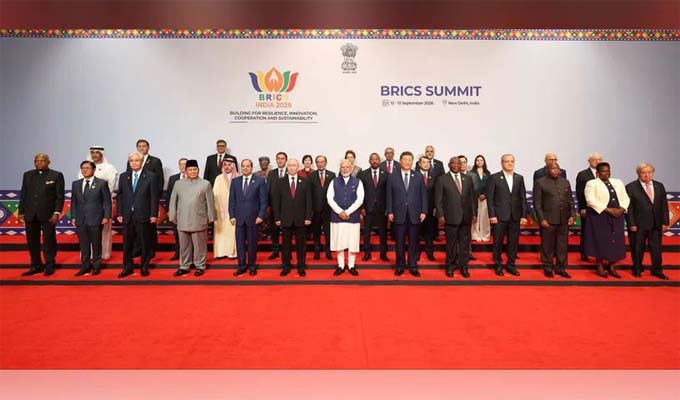
- PM warns against “weaponisation” of technology and critical minerals at 18th BRICS Summit
- From resilient supply chains to early-warning systems, India pushes action-oriented BRICS agenda
- Modi calls for inclusive technology as BRICS seeks “win-win collaboration”
- Startups, farmers, researchers, women and youth brought into India’s people-centric BRICS vision
- India deepens strategic engagement with Philippines, Kazakhstan and Uganda on summit sidelines
- Global South gets stronger voice as expanded BRICS embraces cooperation over confrontation
NE NEWS SERVICE
NEW DELHI, SEPT 13
Prime Minister Narendra Modi on Sunday used the closing session of the 18th BRICS Summit in New Delhi to deliver a pointed warning against the emerging use of technology and critical minerals as instruments of geopolitical leverage, while positioning India’s BRICS presidency around resilience, innovation, cooperation and sustainability.
With Chinese President Xi Jinping seated beside him, Modi cautioned that the “weaponisation of technology and critical minerals” could obstruct common growth, even as the expanded grouping sought to translate its growing geopolitical weight into practical cooperation on supply chains, innovation, agriculture, health and disaster management.
“The weaponisation of technology and critical minerals can create hurdles for common growth. Therefore, we have emphasised inclusivity in the adoption of technology,” Modi said in his closing remarks at Bharat Mandapam.
His message acquired added significance against the backdrop of growing global tensions, disruptions in supply chains and the strategic competition surrounding critical minerals and emerging technologies. The 11-member BRICS grouping has increasingly emerged as a platform representing a substantial share of the Global South, with India seeking to make its expanded architecture more action-oriented rather than merely declaratory.
Modi said India was pleased that, with the support of member states, the summit had converted its shared vision into “win-win collaboration”, in line with the theme — ‘Resilience, Innovation, Cooperation and Sustainability: Shaping the Future for Inclusive Global Growth’.
“Today, this group is uniting different continents, cultures, and development journeys. This is a testament to the growing strength, attraction, and unwavering confidence of BRICS,” he said.
Resilience beyond rhetoric
Reflecting on the lessons of Covid-19, climate disasters, conflicts and supply-chain disruptions, Modi stressed that an interconnected world required an equally interconnected response.
“Today, the global tensions are increasing, which is negatively affecting the common man. Pandemics, climate change disasters and supply chain disruptions have shown that in the current interconnected world, no crisis remains confined to a single region. Therefore, we have placed special focus on enhancing resilience within the BRICS group,” he said.
The proposed BRICS Logistics Supply Chain Cooperation Framework, he said, would make supply chains “more reliable and resilient”, strengthening the ability of member countries to withstand future disruptions.
Innovation formed the second major pillar of the Indian agenda. The BRICS Incubator Network is aimed at connecting startups and incubators across member states, while India has proposed a BRICS Startup Innovation Fund to support innovative and scalable solutions.
The BRICS Network on Digital Agriculture would seek to align AI, geospatial technologies and digital public infrastructure with the practical needs of farmers, opening a new avenue for technology-led agricultural cooperation.
Early warning, early action
India also placed disaster preparedness and health security at the centre of the BRICS agenda.
“A consensus has been reached on a BRICS Integrated Early Warning System for the prevention of and response to infectious diseases. Additionally, Early Warning Data Integration Guidelines have been formulated for disaster management,” Modi announced.
The approach reflects India’s broader argument that global cooperation must move from reacting to crises after they occur to anticipating them, preparing for them and acting before they escalate.
The New Delhi Declaration adopted at the summit similarly reflected the grouping’s effort to build common ground despite differences among members on major geopolitical issues.
BRICS for the people
Modi also sought to widen the constituency of BRICS beyond governments and diplomatic establishments.
“We have made efforts to ensure that BRICS cooperation is not limited to governments alone. We want our entrepreneurs, farmers, researchers, women, youth, and ordinary citizens to become active participants as well,” he said.
This people-centric emphasis was central to India’s effort to present BRICS as a practical platform for development and opportunity, rather than simply another geopolitical bloc.
“Today, this group is uniting different continents, cultures, and development journeys,” Modi said, underscoring the diversity that has accompanied BRICS’ expansion.
Diplomatic outreach across Asia and Africa
On the summit sidelines, Modi intensified India’s bilateral outreach.
In his meeting with Uganda Vice President Jessica Rose Epel Alupo, the two sides reviewed bilateral relations and agreed to deepen cooperation in technology partnerships, capacity building, knowledge sharing, investment facilitation and private-sector collaboration. Modi reaffirmed India’s support for Uganda’s Vision 2040, while both leaders called for closer engagement to strengthen the voice of the Global South.
With Philippines President Ferdinand R. Marcos Jr., Modi discussed expanding cooperation in defence and security, trade and investment, space, railway infrastructure, fintech, education, tourism, science and technology, innovation and people-to-people ties. The leaders also reviewed the progress of the Strategic Partnership established in August 2025 and welcomed the Philippines’ decision to join the Coalition for Disaster Resilient Infrastructure.
His meeting with Kazakhstan President Kassym-Jomart Tokayev covered political ties, trade, defence and security, connectivity, energy, critical minerals, emerging technologies, creative economy and people-to-people relations. Modi also recalled India’s ancient civilisational links with Kazakhstan, with both leaders reaffirming their commitment to strengthening the strategic partnership.
The outreach underscored New Delhi’s effort to connect the BRICS agenda with wider partnerships across Asia and Africa — particularly in critical minerals, technology, connectivity, resilience and development.
As leaders posed for the summit’s family photograph, the visual captured more than diplomatic ceremony: an expanded BRICS attempting to navigate a fractured global landscape through cooperation, resilience and a greater voice for the Global South.