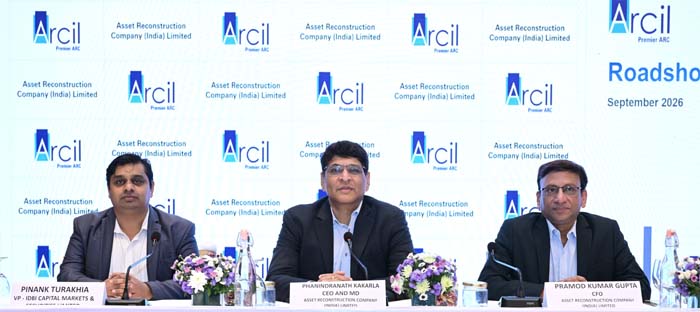
- ₹132–139 price band puts India’s first ARC on the public-market radar
- 27 crore-share OFS opens September 9; anchor bidding on September 8
- 50% QIB, 35% retail and 15% NII reservation; minimum retail bet ₹14,873
- FY26 revenue rises 24% to ₹721.7 crore; PAT climbs 6.7% to ₹351.7 crore
- ₹16,852.6-crore AUM and expanding stressed-asset universe underpin growth narrative
- CEO Phanindranath Kakarla sees ECL creating a larger early-stage stress opportunity
R MANICKAVASAGAM
AHMEDABAD, SEPT 8
India’s business of turning stressed loans into recoverable value is knocking on Dalal Street. Asset Reconstruction Company (India) Ltd (ARCIL), India’s first asset reconstruction company, is set to enter the public markets with a ₹733-crore IPO, betting that its two-decade experience, technology-led recovery capabilities and an evolving stressed-asset landscape can create a durable growth story.
ARCIL has fixed a price band of ₹132–139 per equity share for its IPO, which opens on September 9 and closes on September 11. The entire issue is an Offer for Sale (OFS) of 5.27 crore shares, meaning the company itself will receive no fresh capital from the offering.
The selling shareholders include Avenue India Resurgence Pte Ltd, State Bank of India, Lathe Investment Pte Ltd and The Federal Bank.
Pioneers with experience—and AI in the toolkit
Asked what differentiates ARCIL from other asset reconstruction companies and alternative resolution platforms in an increasingly competitive bad-loan market, Phanindranath Kakarla, MD & CEO, ARCIL, pointed to the company’s pioneering position, experienced leadership and technology capabilities.
“We are the pioneers in this specialised sector having a team of experienced senior personnel. We always deploy the emerging technologies like AI coupled with the experience we have gained over the years to stay ahead of the competitive moat.”
That combination of domain experience and emerging technology is increasingly important as resolution becomes more sophisticated, particularly across retail and SME portfolios.
ARCIL says it has operated since 2002 as India’s first ARC and has built a nationwide presence with 13 offices across 12 states. Its business spans corporate, mid-market and retail stressed assets, with dedicated approaches for different asset classes.
Retail and SME emerge as the next growth engines
ARCIL’s growth strategy is not about moving away from its core business. It remains a pure-play asset reconstruction company, but is positioning retail and SME assets for a larger role in its portfolio.
According to the latest management commentary, corporate assets accounted for about 69% of ARCIL’s FY26 portfolio, while SME contributed around 8% and retail made up the balance. Retail and SME together have grown at a CAGR of close to 56% over the past couple of years, and management expects these segments to continue gaining share.
The fastest growth is currently coming from retail assets originated by NBFCs, although bank-originated retail assets, corporate assets and other retail portfolios are also growing.
ARCIL is also looking at collections-as-a-service, targeting early-stage stressed accounts such as SMA-1 and SMA-2 before they turn into NPAs. The proposed vertical would leverage its existing collections infrastructure, technology and processes.
Importantly, Kakarla has said the company does not intend to diversify beyond asset reconstruction after the IPO. Instead, it plans to deepen its presence across corporate, SME and retail opportunities based on asset quality and resolution potential.
ECL could widen the hunting ground
Another potential catalyst is the proposed Expected Credit Loss (ECL) framework.
ARCIL already acquires both NPAs and non-NPA stressed accounts and expects early-stage stress to become increasingly important once ECL is implemented.
“Some sellers do include non-NPA accounts as part of stress accounts and we buy them. We expect them to become fairly important when ECL is implemented, as there will be faster recognition of really bad assets,” Kakarla has said.
India’s organised credit market has crossed ₹200 lakh crore and is expanding by roughly ₹30 lakh crore annually, according to Kakarla, creating a potentially expanding addressable market for stressed-asset resolution.
Strong financial spine, unusual IPO structure
ARCIL’s FY26 revenue rose 24% to ₹721.7 crore, while PAT increased 6.7% to ₹351.7 crore.
The company had AUM of ₹16,852.6 crore as of FY25 and has built a recovery franchise across corporate, SME and retail assets. Its official business profile says it has managed around ₹1.35 lakh crore of aggregate dues of the Indian banking system over the past two decades.
But investors must remember that this is a 100% OFS. The IPO will enhance visibility, liquidity and the public-market profile of ARCIL, but will not inject new equity capital into the company.
The real test, therefore, lies beyond the listing: Can ARCIL convert its pioneering experience, AI capabilities, growing retail and SME franchise and ECL opportunity into superior and sustainable recoveries?
That could ultimately determine whether India’s first ARC becomes not merely a listed recovery specialist, but a public-market benchmark for the business of turning financial stress into value.