- India’s first high-speed rail service to roll out on the Surat–Bilimora stretch from August 15, 2027, ushering in a new era of mobility
- Nearly 80% of the 508-km Mumbai–Ahmedabad Bullet Train Corridor completed as phased commissioning blueprint unveiled
- Hyderabad to emerge as the next high-speed rail hub with three proposed bullet train corridors and a Mumbai link
- Railway Minister Ashwini Vaishnaw says the transformative network will redefine regional connectivity and economic growth
- Parallel station redevelopment under Nav-Nirmaan gathers pace with 261 railway stations, including key Telangana hubs, undergoing modernisation
NE RAILWAY BUREAU
NEW DELHI, JULY 12
India’s railway story is poised for its most defining chapter since Independence. On August 15, 2027, the nation will witness the launch of its first-ever bullet train, propelling India into the elite league of countries operating high-speed rail networks. The inaugural service on the Surat–Bilimora section of the Mumbai–Ahmedabad High-Speed Rail (MAHSR) Corridor promises to revolutionise inter-city travel, accelerate regional economies and signal the arrival of next-generation transport infrastructure.
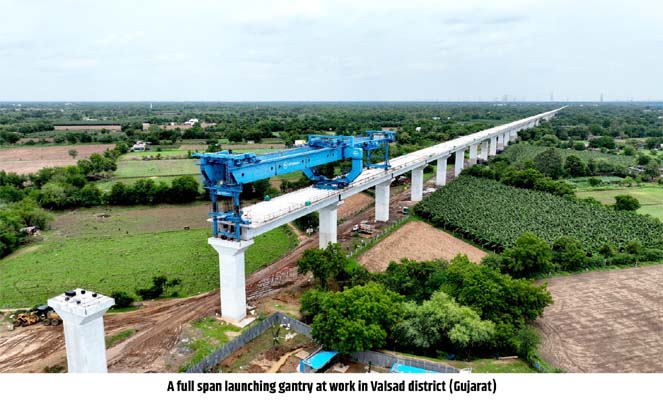
Announcing the roadmap, Union Railway Minister Ashwini Vaishnaw said the country’s flagship 508-km Mumbai–Ahmedabad Bullet Train Corridor will be commissioned in carefully planned phases, enabling passengers to experience India’s first high-speed rail service well before completion of the entire corridor. Nearly 80 per cent of the project has already been completed, with construction gathering momentum across Gujarat and Maharashtra.
The phased rollout will commence with the Surat–Bilimora stretch, followed by Vapi–Surat, Vapi–Ahmedabad, Ahmedabad–Thane, before culminating in the full Mumbai–Ahmedabad operation, creating India’s first seamless high-speed rail corridor linking two of the country’s largest economic powerhouses.
Designed with advanced Japanese Shinkansen technology, the corridor will slash travel time dramatically while offering world-class safety, comfort and operational efficiency. The project is expected to catalyse industrial growth, urban development, tourism and logistics across western India.
Sharing the larger vision for India’s high-speed rail future, Vaishnaw announced that Hyderabad has been identified as the nucleus for three proposed bullet train corridors — Pune–Hyderabad, Hyderabad–Chennai and Hyderabad–Bengaluru. A Hyderabad–Mumbai high-speed rail link is also on the drawing board, promising to reshape connectivity across southern and western India.
“Prime Minister Narendra Modi has given three high-speed bullet train corridors to Hyderabad, which will change its landscape.” — Ashwini Vaishnaw
The Railway Minister said the proposed network would connect vast parts of Telangana while significantly reducing travel time between major metropolitan centres and creating fresh opportunities for commerce, investment and employment.
Alongside the bullet train mission, Indian Railways is simultaneously pursuing one of the world’s largest station redevelopment programmes under the Nav-Nirmaan initiative. As many as 261 railway stations across the country are being transformed into modern transport hubs equipped with upgraded passenger amenities, multimodal integration and enhanced accessibility.
In Telangana, major stations including Secunderabad, Begumpet and HITEC City are among those being comprehensively redeveloped as part of the nationwide railway infrastructure upgrade.
The announcement comes as engineering milestones continue to be achieved on the Mumbai–Ahmedabad High-Speed Rail project, including completion of critical portal beam works and rapid progress on tunnels, bridges and viaducts, keeping the country’s most ambitious rail infrastructure project firmly on course.