R ARIVANANTHAM
CHENNAI, JUNE 18
In a significant medical achievement that underscores the growing role of precision oncology in India, MGM Cancer Institute has successfully treated a 54-year-old woman diagnosed with Stage-II breast carcinoma using advanced internal radiation therapy, or brachytherapy, after breast-conserving surgery.
The treatment, carried out by a multidisciplinary team of surgical and radiation oncologists, enabled the patient to preserve her breast while receiving highly targeted radiation that minimised exposure to vital organs such as the heart and lungs.
The case marks another milestone for the Chennai-based cancer centre, which is increasingly adopting cutting-edge techniques aimed at improving survival rates while enhancing patients’ quality of life.
Precision Medicine Delivers a New Lease of Life
- MGM Cancer Institute successfully treats Stage-II breast cancer using advanced brachytherapy after breast-conserving surgery
- Internal radiation therapy preserves the breast while minimising exposure to the heart, lungs and healthy tissues
- Procedure completed in just four radiation sessions over two days using five precision-guided catheters
- Brachytherapy offers recurrence rates below 5% in Stage-II breast cancer and as low as 1–2% in Stage-I disease
- Experts say the technique is redefining breast cancer care by combining precision treatment with better quality of life
A Highly Targeted Approach to Cancer Care
The patient initially underwent lumpectomy — a surgical procedure to remove the tumour while preserving the breast. To eliminate any remaining microscopic cancer cells and reduce the risk of recurrence, doctors opted for tumour-bed boost brachytherapy, an advanced form of internal radiation therapy.
Unlike conventional external-beam radiation therapy, brachytherapy delivers radiation directly to the area where the tumour was removed. Thin tubes known as catheters are inserted into the breast, allowing doctors to precisely target the tumour bed.
In this case, five catheters were placed in the patient’s breast and radiation was administered in four sessions over a period of two days.
The focused approach not only shortens treatment duration but also significantly reduces radiation exposure to healthy tissues and surrounding organs.
Lower Side Effects, Better Outcomes
According to specialists at MGM Cancer Institute, brachytherapy offers excellent disease control with minimal side effects.
The recurrence rate is as low as 1–2 per cent in Stage-I breast cancer and between 2–5 per cent in Stage-II disease, making it one of the most effective options for selected patients undergoing breast-conserving treatment.
By limiting radiation exposure to healthy tissues, the procedure also helps reduce common side effects associated with conventional radiation therapy, including skin peeling, pigmentation changes, fibrosis and scarring.
Experts Highlight the Advantages
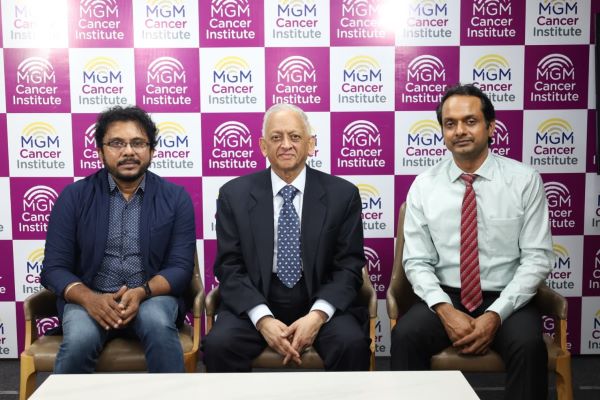
The procedure was performed by teams led by Dr. Sivakumar Mahalingam, Senior Consultant and Surgical Oncologist, and Dr. Alex A. Prasad, Senior Consultant and Radiation Oncologist.
Dr. Alex Prasad said the precision offered by brachytherapy represents a major advancement in cancer care.
“Brachytherapy delivers radiation in a highly targeted manner, ensuring that exposure to surrounding organs remains well within safe limits. Radiation-related damage to nearby organs can be significantly minimised, while side effects such as skin peeling, fibrosis, pigmentation changes and scarring are substantially reduced,” he said.
Dr. Sivakumar Mahalingam emphasised the importance of preserving both the breast and the patient’s quality of life.
“Following surgical removal of the tumour, we performed tumour-bed boost brachytherapy to target residual microscopic cancer cells. One of the primary advantages of brachytherapy is its ability to preserve the breast while minimising radiation exposure to vital organs such as the heart and lungs. A multidisciplinary team approach is essential for achieving optimal outcomes,” he said.
Redefining Breast Cancer Treatment
Dr. M.A. Raja, Director and Senior Consultant, Medical Oncology, said breast cancer treatment has evolved beyond merely removing the tumour.
“Breast-conserving treatment is no longer just about removing the tumour; it is about preserving quality of life. Interstitial brachytherapy allows us to precisely target the tumour bed with radiation after surgery, significantly reducing unnecessary exposure to the heart, lungs and skin. This highly focused approach offers excellent disease control while helping patients return to their normal lives with confidence,” he said.
With precision-guided therapies increasingly becoming the standard of care, MGM Cancer Institute’s latest success demonstrates how advanced technology and multidisciplinary expertise are transforming cancer treatment, giving patients not just longer survival, but also a better quality of life.