- Tri-services converge in Bengaluru to decode future warfare beyond borders and binaries
- From land to cognitive space—India gears up for seamless multi-domain dominance
- Army, Navy push integration, intelligentisation and next-gen combat readiness
- 200+ warship vision and autonomous systems signal maritime transformation
- Think-tanks, global experts and forces unite to script a ‘Whole of Nation’ war doctrine
NE DEFENCE BUREAU
NEW DELHI, APR 10
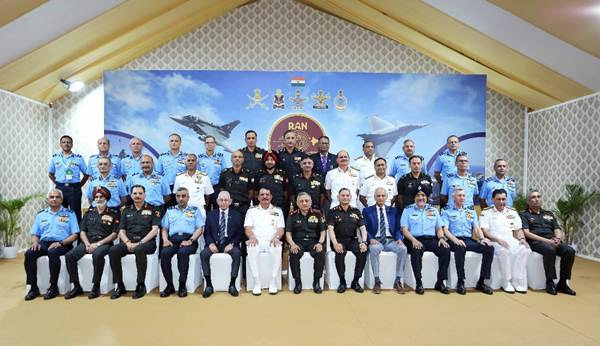
India’s strategic thought leadership took centre stage as the second edition of Ran Samwad—a flagship tri-service seminar—unfolded in Bengaluru, setting the tone for the future of warfare in an increasingly complex and interconnected world.
Held under the aegis of Headquarters Integrated Defence Staff (IDS) and hosted by the Air Force Training Command, the two-day national seminar was inaugurated by Chief of Defence Staff General Anil Chauhan. Anchored around the theme “Multi-Domain Operations (MDO): An Imperative for Addressing Conventional and Irregular Threats,” the forum brings together military leaders, scholars, industry experts and global defence attaches.
In his keynote, Chief of Integrated Defence Staff Air Marshal Ashutosh Dixit outlined a bold transformation in India’s military outlook, asserting that modern warfare now unfolds simultaneously across land, sea, air, space, cyber and cognitive domains. He stressed that for India, Multi-Domain Operations is not a distant concept but an immediate operational necessity.
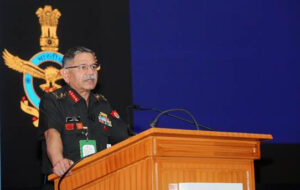
Chief of Army Staff General Upendra Dwivedi delivered a powerful perspective on evolving conflict dynamics, describing today’s battlespace as a “dispersed, undeclared world war.”
“MDO, is not about six domains operating in parallel, but in constant and dynamic interaction, where the weight shifts and the lead changes,” he said.
He emphasised that warfare is no longer confined to maps but exists as a complex, adaptive system demanding real-time cross-domain awareness. Highlighting the Army’s transformation journey, he spoke about operational milestones such as Integrated Battle Groups (IBGs), Divyastra Drone Batteries and Command Cyber Operations Wings. He called for a paradigm shift in leadership:
leaders must “command technology rather than merely operate it” to secure decision superiority.
General Dwivedi also pointed to Operation Sindoor as a testament to growing jointness, while underlining the ultimate goal of a seamless “Whole of Nation” defence architecture.
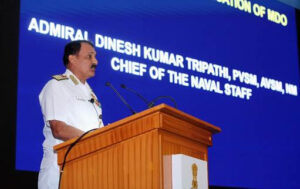
Chief of the Naval Staff Admiral Dinesh K Tripathi presented a futuristic maritime vision rooted in both cutting-edge technology and classical strategic thought. He described the maritime battlespace as a fully interconnected grid stretching from seabed to space.
“We are firmly on course towards being a 200-plus ship Navy by 2035 with each new induction increasingly focused on modularity and technological evolution,” he stated.
He further highlighted the Navy’s push towards uncrewed and autonomous systems under its Vision for Unmanned Systems 2022–30, reinforcing India’s maritime edge in a rapidly evolving security landscape.
The seminar, conducted annually on a rotational basis among the three services, serves as a premier platform for collaborative brainstorming. With participation from senior officers, academia, think tanks, industry leaders and international delegates, Ran Samwad aims to craft a comprehensive roadmap for India’s preparedness in multi-domain conflicts.
The event will culminate on April 10, 2026, with actionable strategies to strengthen India’s integrated warfighting capabilities in an era where boundaries between domains are rapidly dissolving.