PROF ALOK KUMAR KANUNGO
Whenever civilisation is discussed in academic circles anywhere in the world, Indian civilisation inevitably occupies a central place because of its antiquity, continuity and diversity. Yet, the debate surrounding civilisation has always revolved around two critical questions: How do we define a civilisation? And how do we measure its progress?
For decades, historians, archaeologists and social scientists have attempted to answer these questions through political history, cultural studies and philosophical traditions. But an equally important dimension often remains neglected — the scientific and technological foundations of civilisation.
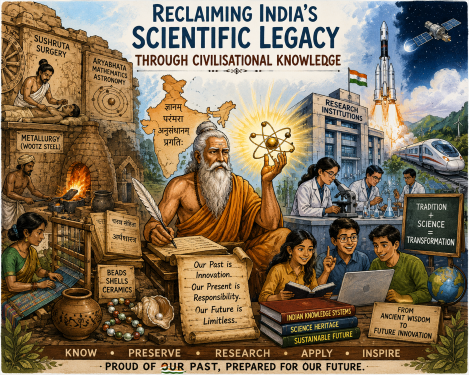
- Indian civilisation possesses one of the world’s richest continuous traditions of science, technology and craftsmanship
- Ancient Indian innovations in metallurgy, textiles, ceramics, mining and paper-making remain globally significant
- Indigenous knowledge systems are rapidly disappearing due to lack of documentation and institutional support
- IIT Gandhinagar’s “History, Science and Technology of Indian Civilisation” initiative is creating a global academic framework for Indian knowledge traditions
- India’s journey toward “Viksit Bharat” requires balancing modern development with preservation of civilisational heritage
A civilisation is not merely remembered through monuments or empires. It survives through its tools, crafts, technologies and systems of knowledge transmission.
India’s Forgotten Technological Heritage
India’s contribution to ancient science and technology is both profound and underappreciated.
From advanced metallurgy and zinc distillation to textile weaving, paper-making, ceramics, mining and bead manufacturing, India developed highly sophisticated technologies centuries before industrial modernity emerged elsewhere.
India’s civilisational greatness lies not merely in its antiquity but in the continuity of its scientific traditions, technological innovations and living knowledge systems. As ancient crafts and indigenous technologies disappear under modern pressures, the country faces an urgent challenge — to document, research and revive the intellectual foundations that once made India a global centre of innovation.
What distinguishes Indian civilisation is not only the existence of these knowledge systems in ancient texts, but their remarkable continuity through living traditions and community practices even today.
Across villages, tribal societies and craft communities, fragments of ancient technological wisdom still survive.
But these traditions are disappearing rapidly.
Modernisation, industrialisation and changing economic patterns have pushed many traditional crafts and indigenous technologies to the brink of extinction.
If these systems are not documented and studied now, future generations may lose access to invaluable scientific and cultural knowledge accumulated over thousands of years.
Learning From Global Models
The world has already witnessed successful efforts to document civilisational knowledge systematically.
One of the greatest examples remains Joseph Needham’s monumental series Science and Civilisation in China, which transformed global understanding of Chinese technological history.
India too has produced remarkable scholarly works such as R.C. Majumdar’s History and Culture of the Indian People and G.C. Pande’s History of Science, Philosophy and Culture in Indian Civilization.
However, the need of the hour is more focused research into India’s material culture — the history of tools, artefacts, crafts, manufacturing techniques and technological evolution.
Such studies bridge archaeology, ethnography, material science and history.
More importantly, they allow us to scientifically validate ancient texts and oral traditions through interdisciplinary research.
Knowledge Keepers Must Be Brought to the Centre
India’s traditional knowledge systems are deeply rooted in ecology, regional diversity and local cultures.
The craftsmen, artisans, tribal communities and hereditary practitioners who preserved these traditions over centuries are not merely labourers — they are knowledge keepers.
Unfortunately, academic systems often marginalise these communities instead of integrating them into mainstream research.
To preserve India’s technological heritage meaningfully, scholars, scientists, artisans and practitioners must come together on a common intellectual platform.
This requires:
- Theme-specific research programmes
- Dedicated academic departments
- Long-term field documentation
- Institutional archives
- Interdisciplinary collaboration
- Public engagement with indigenous technologies
Without such systematic efforts, India risks celebrating its heritage symbolically while losing its practical knowledge base permanently.
IIT Gandhinagar’s Unique Academic Initiative
Recognising this urgent need, IIT Gandhinagar since 2015 has initiated a unique academic movement titled History, Science and Technology of Indian Civilisation.
These week-long workshops and conferences focus on specific knowledge traditions and material cultures of India.
Unlike superficial conclaves dominated by short speeches, these programmes encourage deep academic engagement between scholars and students.
The first conference, held in 2015, focused on stone beads. Later editions explored glass, ceramics and Indian metallurgy.
The ceramic conference was organised jointly with the Tamil Nadu State Archaeology Department at IIT Madras in 2024, while the latest programme on Indian metals and metallurgy was held in January 2026 at IIT Gandhinagar.
Future themes include textiles and shell technologies.
These initiatives have resulted in the publication of the Ancient Indian Artefacts series — an academic resource integrating archaeology, ethnography, material science and global connections.
Today, these books are being incorporated into international academic curricula, placing Indian knowledge systems firmly on the global scientific map.
Beyond Conferences: Building Cultural Ambassadors
The success of these programmes lies in their structure.
Leading scholars from across the world are invited irrespective of nationality, religion or background, ensuring academic rigour and openness.
Participants engage in extended discussions, workshops and collaborative learning rather than ceremonial presentations.
More importantly, these programmes train students to become future researchers and cultural ambassadors capable of interpreting India’s civilisational knowledge scientifically and globally.
This approach aligns strongly with the Government of India’s growing emphasis on Indian Knowledge Systems (IKS) under the vision of Viksit Bharat.
Vikas and Virasat Must Move Together
India today stands at a crucial civilisational moment.
As the nation aspires to become a global economic and technological power, it must also preserve the intellectual traditions that shaped its identity for millennia.
Development (Vikas) and heritage (Virasat) cannot function as opposing ideas.
A truly developed India must integrate modern innovation with historical consciousness.
Studying the history, science and technology of Indian civilisation is therefore not an exercise in nostalgia. It is an investment in intellectual self-confidence, sustainable development and cultural continuity.
If India is serious about rediscovering what it once excelled in, then documenting and researching its technological heritage is not optional — it is essential.
(Prof. Alok Kumar Kanungo is Associate Research Professor (Archaeology), Department of Humanities and Social Sciences, IIT Gandhinagar, He can be contacted – alok.kanungo@iitgn.ac.in)