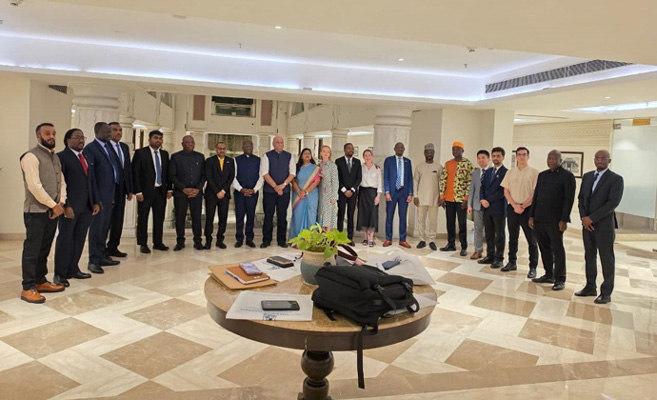
- Rashtriya Raksha University convenes ambassadors, high commissioners and senior foreign mission representatives in New Delhi to expand collaboration in law enforcement, national security education and specialised capacity building
- Talks focus on admissions to Master’s programmes, scholarship pathways, customised short-term training and broader institutional tie-ups for upskilling security, policing and government personnel from partner countries
- The outreach builds on RRU’s growing global footprint: more than 2,000 law-enforcement officials from 84 countries trained under ITEC, with officers from 15 nations currently enrolled in the university’s regular postgraduate programmes
- As an Institution of National Importance under the Ministry of Home Affairs, RRU positions itself as an integrated ecosystem for security education, research and training spanning policing, forensics, cyber defence, narcotics control, maritime security and criminal justice
- The New Delhi engagement signals a larger ambition — to turn India’s security education model into a platform for international cooperation against terrorism, cyber threats, trafficking, transnational crime and other emerging security challenges
NE EDUCATION BUREAU
GANDHINAGAR, JUNE 25
In a significant diplomatic outreach aimed at deepening India’s global engagement in security education, policing and law-enforcement capacity building, Rashtriya Raksha University (RRU) has brought ambassadors, high commissioners and senior foreign mission representatives onto a common platform in New Delhi to explore a new wave of academic and institutional partnerships.
The Get-Together and Discussion on Collaboration with RRU, hosted by the Institution of National Importance under the Ministry of Home Affairs, sought to position the Gujarat-based university as a key Indian gateway for international training, postgraduate education and specialised skilling in internal security and allied domains. Invitations were extended to foreign embassies and missions based in the national capital, underlining RRU’s growing effort to build a wider network of cross-border cooperation in law enforcement, cybersecurity, forensics and strategic security studies.
Held at Garvi Gujarat Bhavan, New Delhi, on Tuesday, the programme brought together senior diplomatic representatives from partner countries for a presentation and structured discussion on possible collaboration models. The session was led by Ravish Shah, Director, International Cooperation Relations Branch (ICRB), RRU), followed by an interactive question-and-answer engagement and a networking dinner.
At the heart of the discussions was a broad partnership menu: admissions to RRU’s regular Master’s programmes under special scholarship pathways, short-term online and offline training modules, and deeper institutional collaboration for workforce upskilling and reskilling in security education. The idea was not merely to attract foreign students, but to offer partner nations a practical training and knowledge-sharing platform in areas that increasingly define modern governance and public safety.
RRU describes itself as the world’s first integrated ecosystem dedicated to national security education, research and training, combining academic programmes with operationally relevant capacity-building for law-enforcement and security professionals. Its training and academic portfolio spans policing, road safety and traffic enforcement, anti-human trafficking interventions, narcotics control and investigation, maritime security, scientific investigation methods, criminal and military law, cybersecurity and other emerging security domains.
The university’s international pitch rests substantially on its existing record. Working in collaboration with the Ministry of External Affairs under the Indian Technical and Economic Cooperation (ITEC) framework, RRU says it has already trained more than 2,000 law-enforcement officials from 84 partner countries in specialised areas such as forensics, cybersecurity and policing. In addition, officials from 15 countries across South Asia, Southeast Asia, Africa and Oceania are currently enrolled in the university’s regular two-year Master’s programmes for law-enforcement officials.
As part of its international cooperation framework, RRU has also offered a range of engagement models to partner countries and institutions, including customised training programmes for law-enforcement officials, deputation of subject experts to conduct training abroad, structured online learning modules for security and government personnel, postgraduate admissions for international officers, and support in establishing advanced laboratories. These proposed labs could cover fields such as cybersecurity, digital forensics, artificial intelligence, blockchain, Internet of Things, geographic information systems, cyber defence systems, open-source intelligence and human performance.
University officials expressed confidence that such engagement with the diplomatic community would further strengthen academic ties, professional exchange and institutional cooperation between India and partner countries. They also reiterated RRU’s commitment to advancing global security cooperation, in line with the vision articulated by the Prime Minister, who has described the university as a global leader in internal security, correctional administration and law enforcement.
For RRU, the New Delhi outreach was therefore more than a ceremonial diplomatic gathering. It was an effort to project India’s security university model outward — as a platform where education, training, technology and international cooperation intersect to prepare professionals for the increasingly complex realities of terrorism, cybercrime, trafficking, organised crime and borderless security threats.