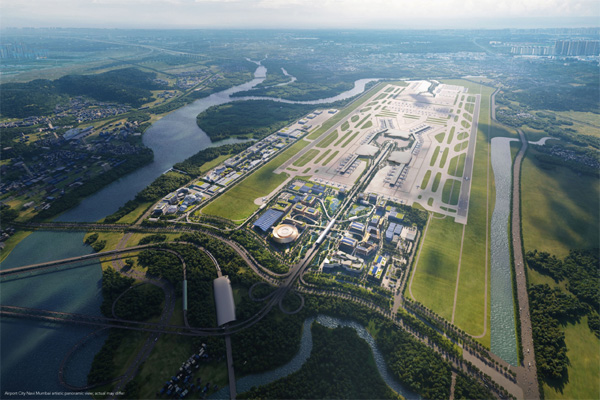
- Integrated airport cities to rise across more than 655 acres spanning Mumbai, Navi Mumbai, Ahmedabad, Lucknow, Jaipur and Guwahati
- Over ₹20,000 crore first-phase investment to create hotels, retail, convention centres, offices and entertainment districts seamlessly connected to airports
- Nearly 22 million sq. ft. of mixed-use development planned, with Mumbai Metropolitan Region emerging as the flagship growth hub
- Global airport-city models from Singapore, Dubai, Amsterdam and Seoul to shape India’s aviation-led urban transformation
- LEED Gold-certified sustainable developments expected to unlock tourism, investments, employment and long-term economic growth
NE BUSINESS BUREAU
MUMBAI, JUNE 26
In one of India’s most ambitious airport-led urban development initiatives, Adani Airport City Limited (AACL), a wholly owned subsidiary of Adani Airport Holdings Limited (AAHL), has unveiled a ₹20,000-crore first-phase programme to build integrated airport cities across six airports, transforming aviation hubs into vibrant centres of commerce, tourism, hospitality and urban living.
Spread across a land bank exceeding 655 acres in Mumbai, Navi Mumbai, Ahmedabad, Lucknow, Jaipur and Guwahati, the master-planned developments will feature nearly 22 million square feet of mixed-use infrastructure, combining premium hotels, offices, retail destinations, entertainment venues, food and beverage hubs, convention centres and public spaces within seamlessly connected, walkable districts.
The largest share of the development will be concentrated in the Mumbai Metropolitan Region (MMR), where nearly 440 acres have been earmarked across Mumbai and Navi Mumbai airports. Around 70 per cent of the total investment will flow into these two projects, underscoring MMR’s role as India’s foremost commercial, financial and aviation gateway.
Designed as natural extensions of airport ecosystems, the developments will integrate airports with Metro and city transport networks, enabling travellers, businesses and local communities to access hospitality, workplaces, shopping, dining, entertainment and convention facilities within a unified urban environment.
Jeet Adani, Director, AAHL, said: “Around the world, the most successful airport districts have become centres of commerce, tourism and urban growth. As India’s aviation market expands, airports have an opportunity to create value far beyond aviation. We are creating a network of integrated urban destinations where airports become catalysts for investment, employment, better passenger experiences and the long-term growth of the cities they serve.”
Drawing inspiration from globally renowned airport districts such as Singapore’s Changi, Dubai International, Amsterdam’s Schiphol and Seoul’s Incheon, the initiative seeks to introduce a globally proven airport-city model to India’s rapidly expanding aviation sector.
“These developments are being designed with leading global design and engineering partners and informed by emerging trends in hospitality, retail, workplaces and entertainment,” Jeet Adani added.
“Our objective is to create vibrant districts that combine connectivity with experience, generating economic activity, employment and long-term value for the communities around them.”
Unlike conventional real estate projects, the Airport City model places connectivity, mobility and user experience at its core. Hotels, commercial offices, retail outlets, entertainment destinations and convention facilities will be integrated into a single master-planned ecosystem, creating vibrant urban districts that contribute to the long-term economic vitality of surrounding cities.
As part of the programme, AAHL has already entered into hotel management agreements with IHG Hotels & Resorts for five luxury and premium hotels, including the India debut of the Kimpton brand. The company is also partnering with leading domestic and international players across hospitality, retail, food and beverage, and entertainment.
Sustainability forms a central pillar of the initiative. Every Airport City project has secured Leadership in Energy and Environmental Design (LEED) Gold pre-certification from the U.S. Green Building Council (USGBC), reflecting a strong emphasis on sustainable design, resource efficiency, walkability and high-quality public spaces.
At the launch, AACL also recognised its key project partners, including global architecture firms Kohn Pedersen Fox (KPF), Benoy and Znera Space; construction leaders Larsen & Toubro (L&T), Tata Projects Ltd and PSP Projects Ltd; and consulting firms CBRE, JLL and Cushman & Wakefield, which are helping shape the next generation of India’s airport-led urban landscape.