R ARIVANANTHAM
CHENNAI, APR 2
In a landmark medical achievement, SRM Prime Hospital has performed India’s first-ever right axillary artery-based Transcatheter Aortic Valve Replacement (TAVR/TAVI)—a rare, life-saving alternative when all conventional access routes fail.

- 73-year-old with failing heart finds new lease of life through rare access route
- When leg arteries failed, surgeons turned to shoulder artery in a high-precision breakthrough
- Minimally invasive valve replacement offers hope to high-risk elderly patients
- Patient walks home in three days after complex, first-of-its-kind intervention
The pioneering procedure was carried out on a 73-year-old patient suffering from decompensated heart failure caused by severe calcific aortic stenosis, a condition where calcium deposits stiffen and narrow the aortic valve, severely restricting blood flow.
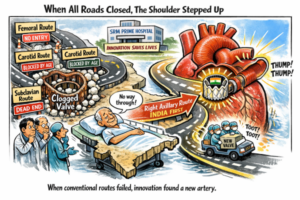
When Every Route Closed, Innovation Opened One
Typically, TAVR procedures are performed through the femoral artery in the leg. However, in this case, all standard pathways—femoral, transcarotid, transcaval, and left subclavian—were deemed unsuitable due to vascular complications such as narrowing, blockages, and unfavourable anatomy.
Faced with limited options, the medical team chose a highly challenging but viable alternative—the right axillary artery located beneath the shoulder.
This marked a historic shift in approach, requiring exceptional precision and advanced planning.
A High-Stakes Procedure, A Swift Recovery
Using a thin catheter-based delivery system, doctors successfully implanted an artificial valve via the shoulder artery—completely avoiding open-heart surgery.
The outcome was remarkable:
- Patient discharged within 3 days
- Rapid recovery with minimal trauma
- Resumed normal daily activities
Expert Voices Behind the Breakthrough
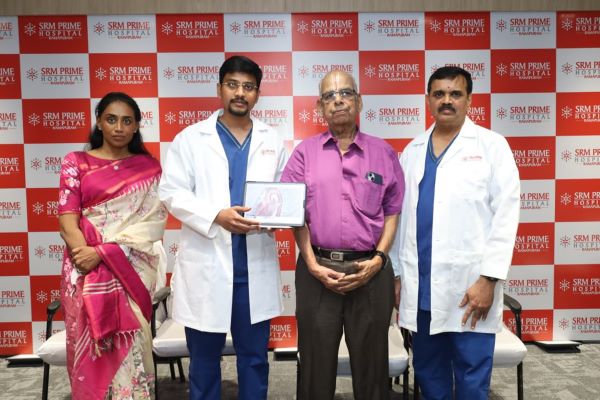
Announcing the rare feat at the press conference, Dr. Balamurugan S, Consultant – Interventional Cardiology, SRM Prime Hospital said,“The patient exhibited features of decompensated heart failure, where the heart is unable to pump effectively. Our evaluation confirmed calcific severe aortic stenosis, a narrowing of the aortic valve caused by calcium deposits that restrict blood flow. Given his age and condition, we opted for TAVR/TAVI; however, none of the standard access routes such as femoral, transcarotid, transcaval or Left subclavian, were feasible. The only viable option was the right axillary artery. We therefore performed this entirely percutaneous right trans-axillary TAVR, an India-first, using an advanced catheter-based valve delivery system.”
He further said, “Modern treatments like TAVR provide safe and minimally invasive options, as there is less surgical trauma and faster recovery options, especially for elderly patients or those at high risk for open-heart surgery. In this case, it required advanced pre-procedure planning and precise catheter manipulation due to the tortuous course of the artery, along with expertise in alternative vascular access techniques. We are happy that our team, with utmost dedication to the quality outcome, performed the first of the kind procedure in India, and saved the senior citizen’s life.”
Dr. P Balasubramanian Senior Consultant, Cardiothoracic and Vascular Surgery, SRM Prime Hospital was also present at the media briefing.
In a statement, Dr. A. Thomas George, Senior Consultant – Internal Medicine & Diabetology said, “Patients undergoing advanced procedures like TAVR are often elderly and have multiple underlying health conditions that need careful medical management. Our focus is on optimising these conditions and ensuring the patient remains stable throughout the treatment journey.”
Understanding the Silent Threat: Aortic Stenosis


- Affects 2–7% of people above 65 years
- Caused mainly by age-related valve degeneration
- Can also occur in chronic kidney disease patients
Warning Signs Not to Ignore
- Breathlessness
- Fatigue on mild exertion
- Chest discomfort
- Fainting spells
Early detection is crucial, as untreated cases may lead to heart failure or sudden cardiac death.
A New Frontier in Cardiac Care
This breakthrough not only underscores SRM Prime Hospital’s clinical excellence but also expands the boundaries of minimally invasive cardiac interventions in India.
For elderly patients once deemed inoperable, the shoulder may now hold the key to a second heartbeat.