
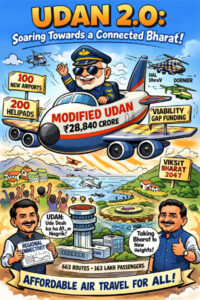
- 10-year roadmap to transform regional aviation, power Tier-2 & 3 growth, and make flying truly inclusive
- 100 new airports, 200 helipads, ₹10,043 crore airline support to reshape India’s connectivity grid
- From remote hills to island regions, Modified UDAN targets seamless last-mile access and emergency reach
- Indigenous aviation boost with HAL Dhruv, Dornier procurement under Atmanirbhar Bharat vision
- 44 lakh flights, 163 lakh passengers mark strong base as scheme enters next growth orbit
NE AVIATION BUREAU
NEW DELHI, MAR 25
In a decisive leap towards democratising air travel and deepening regional connectivity, the Union Cabinet chaired by Prime Minister Narendra Modi has approved the Modified UDAN (Ude Desh ka Aam Nagrik) Scheme, with a massive outlay of ₹28,840 crore over 10 years (FY 2026–27 to FY 2035–36).
The revamped scheme signals a bold new phase in India’s aviation journey—aimed at bridging geographic divides, unlocking economic potential in smaller cities, and making affordable flying a reality for millions.
A bigger, broader vision for inclusive aviation
The Modified UDAN is designed as a holistic intervention, combining infrastructure creation, airline viability, last-mile connectivity, and indigenous capacity building.
It reinforces the government’s push to ensure that aviation growth is not confined to metros, but reaches remote, hilly, island and aspirational regions, integrating them into the national economic mainstream.
Welcoming the move, Civil Aviation Minister Ram Mohan Naidu said: “Today’s Cabinet approval for the Modified UDAN Scheme has given a renewed thrust to Hon’ble Prime Minister Shri Narendra Modi Ji’s commitment to make air travel more inclusive. The UDAN scheme was launched in 2016 with Hon’ble PM’s vision to democratize flying in the country. And today’s historic decision to allocate unprecedented budgetary support of ₹28,840 crore reflects NDA Government’s strong belief and commitment in Viksit UDAN as a pathway to Viksit Bharat.”
He added: “Modified UDAN has been envisioned as a further enabler for connecting Tier 2 & 3 cities to the country’s aviation map in a sustainable manner… the ultimate beneficiary… will be the common man, bringing the vision of ‘Ude Desh ka Aam Nagrik’ to reality.”
Key Pillars of the Modified UDAN Scheme
🔹 Infrastructure Expansion
- 100 airports to be developed from unserved airstrips
- ₹12,159 crore earmarked to scale aviation infrastructure
🔹 Sustaining Regional Aerodromes
- O&M support for ~441 aerodromes
- Financial cushion for low-traffic airports in early years
🔹 Last-Mile Connectivity Boost
- 200 modern helipads in hilly, remote and island regions
- Critical for healthcare, disaster response, and accessibility
🔹 Airline Viability Support
- ₹10,043 crore Viability Gap Funding (VGF) over 10 years
- Tapered support model to ensure long-term sustainability
🔹 Atmanirbhar Aviation Push
- Procurement of HAL Dhruv helicopters and HAL Dornier aircraft
- Strengthening domestic aerospace manufacturing ecosystem
Building on a strong foundation
Since its launch in 2016, UDAN has already transformed regional aviation:
- 663 routes operationalised
- 95 airports, heliports, water aerodromes connected
- 3.44 lakh flights operated
- Over 163 lakh passengers served
These achievements have laid a robust platform for the scheme’s next phase.
Minister of State for Civil Aviation Murlidhar Mohol noted: “Air travel is no longer a privileged access… The success of UDAN over the last nine years has demonstrated the power of regional connectivity in changing lives and opening up new opportunities. With Modified UDAN, we are building on that momentum through stronger infrastructure, enhanced viability support, and a sharper focus on last-mile connectivity.”
Economic & Social Impact: Beyond Aviation
The scheme is expected to trigger multi-sectoral gains:
- Boost to trade, tourism, and investments in Tier-2 & 3 cities
- Faster emergency medical access in remote areas
- Integration of local economies with national markets
- Job creation and growth of regional airlines ecosystem
More importantly, it positions aviation as a tool of social inclusion, reducing travel time and connecting underserved communities to opportunities.
Towards Viksit Bharat 2047
The Modified UDAN aligns with India’s long-term vision of Viksit Bharat 2047, combining connectivity, sustainability, and self-reliance. By integrating infrastructure, policy support, and indigenous capability, the scheme lays the groundwork for a resilient, inclusive, and globally competitive aviation ecosystem.