R ARIVANANTHAM
CHENNAI, APR 14
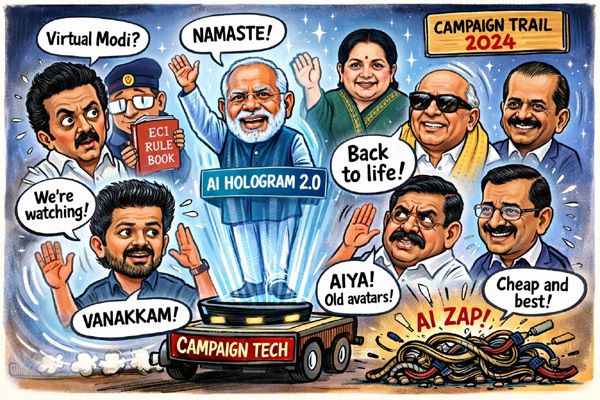
Tamil Nadu’s political arena is witnessing a dramatic technological shift, as artificial intelligence-powered holograms emerge as the newest disruptor in election campaigning—blending spectacle with strategy and raising fresh questions on ethics and regulation.
TVK candidate in Kumbakonam uses a full hologram of Vijay…. pic.twitter.com/eWooTr2EKk
— Vasudha Venugopal (@Vasudha156) April 13, 2026
In a striking demonstration in Kumbakonam, a holographic projection of actor-turned-politician Vijay, leader of the Tamilaga Vettri Kazhagam, captivated crowds by simulating his physical presence. Mounted on a moving vehicle, the projection delivered a lifelike address—complete with synchronised speech and gestures—momentarily blurring the line between reality and virtuality.
- From star power to software power—AI-driven holograms storm Tamil Nadu’s election trail
- Viral ‘virtual Vijay’ in Kumbakonam signals a new era of immersive political outreach
- From Modi’s 2014 experiment to AI-enhanced avatars, campaign tech takes a quantum leap
- Parties divided over ethics, authenticity, and emotional manipulation in digital canvassing
- Election Commission sharpens guidelines to regulate deepfakes and synthetic campaigning
- Cost-effective, scalable, and viral—AI tools reshape voter engagement, especially among youth
The clip quickly went viral, signalling how AI-backed visual technology is transforming voter outreach into a high-impact, immersive experience.
From Modi’s Holograms to AI Avatars
While holographic campaigning is not entirely new, its current evolution marks a significant leap. Prime Minister Narendra Modi was among the first global leaders to deploy 3D hologram rallies during the 2014 Indian general election, enabling him to address multiple locations simultaneously.
Globally, early experiments with holographic political appearances were seen in European campaigns, but India’s scale and diversity turned it into a powerful mass-outreach tool. What sets the Tamil Nadu experiment apart is the integration of AI—bringing enhanced lip-syncing, natural body language, and real-time adaptability.
Cross-Party Curiosity, Competitive Adoption
The company behind the Kumbakonam projection revealed a surge in enquiries from candidates across party lines, reflecting a growing appetite for tech-driven campaigning. Requests have even been made to recreate digital avatars of iconic leaders such as M Karunanidhi and J Jayalalithaa—underscoring the emotional resonance such technology can evoke.
Political players in neighbouring states like Andhra Pradesh and Karnataka are also exploring similar tools, even outside active election cycles.
A senior campaign strategist associated with the project said,
“AI holograms allow leaders to be everywhere at once. In a state like Tamil Nadu, where star appeal matters, this can be a game-changer.”
Parties React: Innovation vs Integrity
Reactions from political parties have been sharply divided.
A spokesperson from the ruling Dravida Munnetra Kazhagam welcomed technological innovation but cautioned against misuse: “Technology should enhance democracy, not distort it. There must be safeguards to prevent misleading content.”
Leaders from the opposition All India Anna Dravida Munnetra Kazhagam expressed concern over emotional manipulation: “Recreating leaders or projecting them virtually can influence voters in ways that may not be entirely ethical.”
Meanwhile, emerging parties like TVK see it as levelling the playing field. A party insider noted, “AI allows us to connect with voters at scale without the logistical constraints of physical rallies.”
ECI Tightens the Rulebook
With the rapid rise of AI-driven campaigning, the Election Commission of India has stepped in to regulate its use.
Officials point to existing guidelines under the Model Code of Conduct, which now extend to digital and synthetic media. Political parties are required to disclose AI-generated content, avoid deepfakes, and ensure that no misleading or manipulated visuals are circulated.
An ECI official said, “Transparency is key. Any AI-generated campaign material must be clearly identified. Misuse, especially in the form of deepfakes, will attract strict action.”
The Commission is also exploring stricter verification mechanisms and watermarking protocols to distinguish authentic content from synthetic fabrications.
High Impact, Lower Cost
Beyond its visual appeal, AI hologram campaigning is proving to be cost-effective and scalable. With pricing starting at around ₹50,000 per day, candidates can reach multiple constituencies without the logistical burden of travel.
Executed by compact teams of engineers using advanced 3D hologram fan display systems, these campaigns are particularly effective in rural and semi-urban settings, where novelty and accessibility drive engagement.
However, challenges remain—ranging from maintaining projection clarity on moving vehicles to mitigating environmental disruptions.
The Road Ahead
Political analysts believe that AI-powered campaigning is here to stay. As younger, tech-savvy voters become a decisive demographic, digital innovation is increasingly shaping electoral narratives.
“This is not just a gimmick—it’s the future of political communication,” said a Chennai-based political observer. “The real question is how responsibly it will be used.”
As Tamil Nadu heads towards a high-stakes electoral battle, one thing is clear: the campaign trail is no longer just about roadshows and rallies—it’s about algorithms, avatars, and the art of virtual persuasion.