

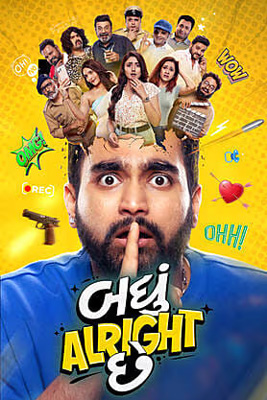
- Director Umang Vyas crafts an emotionally rooted entertainer where misunderstandings become mirrors of modern family life and laughter flows naturally from everyday realities
- Viraj Ghelani delivers effortless charm while veteran Chetan Daiya lends emotional gravitas, proving that seasoned supporting actors often become a film’s silent backbone
- Jerry Silvester Vincent’s understated music, polished cinematography, crisp editing and contemporary production values reflect Gujarati cinema’s growing creative and technological maturity
- Backed by Yoodlee Films, ‘Badhu Alright Chhe’ emerges as a culturally rooted yet universally relatable family entertainer that could rank among the finest Gujarati releases of the year
SEO Keywords: Badhu Alright Chhe review, Gujarati film review 2026, Viraj Ghelani review, Chetan Daiya performance, Umang Vyas director, Gujarati family comedy, Jerry Silvester Vincent music, Gujarati cinema review, Yoodlee Films Gujarati movie, Badhu Alright Chhe cast, Gujarati comedy drama, latest Gujarati films
R MANICKAVASAGAM
In an era when cinema increasingly depends on visual spectacle, high-octane action and franchise storytelling, “Badhu Alright Chhe” quietly reminds audiences that some of the finest stories are born inside ordinary homes, amid family arguments, awkward silences and the collective illusion that everything is perfectly under control.
Director Umang Vyas transforms a familiar Gujarati household into a canvas of humour, misunderstandings and emotional vulnerability, creating a slice-of-life entertainer that feels less like a scripted film and more like an affectionate visit to one’s own extended family.
The title itself becomes the film’s philosophy. Everyone insists that “everything is alright” even when life is clearly falling apart—a contradiction that fuels both its comedy and its emotional resonance.
Humour Rooted in Human Behaviour
The film’s greatest strength lies in its refusal to manufacture comedy through exaggerated situations or slapstick excess.
Instead, it mines laughter from recognisable family dynamics, everyday conversations, generational misunderstandings and the peculiar resilience with which middle-class households navigate crises.
Every comic moment carries traces of truth, making the audience laugh not at the characters but with them.
The screenplay cleverly explores denial as a universal human instinct. Families often postpone difficult conversations, hide uncomfortable truths and convince themselves that problems will resolve on their own. “Badhu Alright Chhe” transforms that emotional reality into consistently engaging entertainment without losing sight of its deeper human observations.
Viraj Ghelani Leads with Natural Ease
Viraj Ghelani shoulders the narrative with remarkable spontaneity.
Having built a loyal digital audience through relatable humour, he successfully translates that natural charisma onto the big screen without resorting to theatrical exaggeration. His comic timing remains effortless, his emotional moments understated and his screen presence refreshingly authentic.
Rather than dominating the ensemble, he becomes an integral part of its rhythm, allowing relationships to define the narrative instead of star power.
Chetan Daiya: The Quiet Strength of the Film
One of the film’s understated triumphs is veteran actor Chetan Daiya.
In an industry where supporting performances often go unnoticed, Daiya demonstrates how experience can elevate an ensemble drama.
He does not chase applause through loud performances or dramatic monologues. Instead, his restraint, measured expressions and understated authority provide emotional stability to scenes built around confusion and chaos.
His character quietly anchors the family’s emotional landscape, serving as a bridge between generations while lending authenticity to every interaction.
Long after individual comic moments fade from memory, Daiya’s dignified presence continues to resonate, proving once again that exceptional character actors often become the invisible pillars upon which memorable family dramas stand.
An Ensemble That Feels Like a Real Family
Jhanvi Gurnani, Sharad Vyas, Morli Patel and the supporting cast contribute to an ensemble that feels lived-in rather than assembled.
The chemistry among the actors avoids artificial sentimentality and instead captures the warmth, disagreements and imperfections that define real Gujarati households.
That authenticity becomes one of the film’s greatest emotional assets.
Direction That Trusts Gujarati Identity
Umang Vyas deserves considerable credit for resisting the temptation to imitate mainstream Bollywood formulas.
Instead, he embraces Gujarati language, culture, family traditions and urban middle-class realities with confidence.
The film demonstrates that regional cinema need not abandon its identity to achieve wider appeal. On the contrary, its strongest universal emotions emerge precisely because they remain deeply rooted in local experiences.
Its exploration of contemporary families navigating changing aspirations, generational shifts and modern lifestyles gives the story relevance far beyond Gujarat.
Music That Understands Restraint
Composer Jerry Silvester Vincent adopts an approach increasingly rare in commercial cinema.
Rather than interrupting the narrative, the songs emerge organically from emotional transitions and family relationships.
The background score deserves particular appreciation for amplifying humour and sentiment without dictating audience emotions.
Instead of overwhelming scenes, the music quietly supports them, creating an atmosphere that feels warm, intimate and enduring.
The soundtrack may not chase chartbuster popularity, but it succeeds in enriching the storytelling with remarkable subtlety.
Technology as an Invisible Storyteller
Perhaps the most encouraging aspect of “Badhu Alright Chhe” is its technical refinement.
Its cinematography captures contemporary Gujarati life through vibrant yet natural visuals that avoid unnecessary ornamentation.
Fluid camera movements, balanced compositions and thoughtful lighting create a polished cinematic language that reflects the industry’s evolving confidence.
The editing maintains energetic momentum despite a narrative built on escalating misunderstandings, ensuring that comic sequences remain fresh and emotionally engaging.
Production design, sound engineering and overall visual execution collectively demonstrate how technology today serves storytelling best when audiences barely notice its presence.
Rather than showcasing technical extravagance, the film showcases technical maturity.
Gujarati Cinema Comes of Age
Beyond its entertainment value, “Badhu Alright Chhe” symbolises an important milestone in the evolution of Gujarati cinema.
Recent years have witnessed filmmakers moving beyond folklore and rural narratives towards contemporary urban stories grounded in local culture but driven by universal emotions.
Backed by Yoodlee Films, this production reflects an industry increasingly willing to invest in polished storytelling, ensemble performances and sophisticated technical standards.
It signals that Gujarati cinema is no longer merely a regional industry but an emerging creative force capable of speaking confidently to audiences across linguistic boundaries.
Where the Film Must Sustain Its Momentum
If there is one area demanding sustained execution, it lies in screenplay discipline.
Narratives driven by escalating misunderstandings risk repetition if emotional progression fails to evolve alongside comedy.
Fortunately, “Badhu Alright Chhe” largely avoids that trap by allowing its characters to grow organically, though tighter pacing in a few stretches could have elevated the experience even further.
Its emotional resolution succeeds because it feels earned rather than manufactured, leaving audiences with reflection rather than forced sentimentality.
Verdict
“Badhu Alright Chhe” succeeds precisely because it never strives to become extraordinary.
It celebrates ordinary people, familiar conversations and everyday confusion with honesty, humour and affection.
Powered by Viraj Ghelani’s natural performance, quietly enriched by Chetan Daiya’s remarkable supporting turn, complemented by Jerry Silvester Vincent’s sensitive musical score and elevated through polished technical craftsmanship, the film emerges as one of the most wholesome Gujarati family entertainers in recent years.
It reminds viewers that life rarely unfolds according to plan, misunderstandings often become memories, and families somehow find their way through every storm together.
In the end, “Badhu Alright Chhe” is not merely a reassuring phrase repeated by its characters—it becomes a philosophy of resilience, togetherness and hope.


