- Kutch rail corridor capacity expansion headlines four landmark projects approved across Gujarat, Maharashtra, West Bengal and Madhya Pradesh
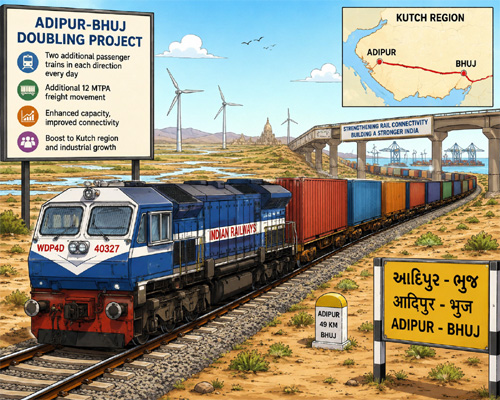
- Adipur-Bhuj doubling to unlock 12 MTPA freight capacity and facilitate two additional passenger trains in each direction every day
- ₹405-crore signalling modernisation, ₹172-crore Somtane-Chikhli freight chord line and ₹139-crore Indore ROB rebuild to transform rail efficiency nationwide
- Projects aligned with Indian Railways’ vision of future-ready infrastructure, enhanced safety, seamless freight movement and multimodal connectivity
- Capacity augmentation, digital signalling, urban mobility and logistics optimisation underscore India’s next-generation railway transformation agenda
- Strategic investments expected to strengthen industrial growth, decongest key corridors, improve passenger convenience and accelerate economic development
NE INFRASTRUCTURE BUREAU
NEW DELHI, JUNE 17
In a major boost to India’s railway infrastructure, connectivity and freight logistics, Indian Railways has approved four strategic projects worth over ₹1,209 crore, with the ₹493-crore Adipur-Bhuj Doubling Project in Gujarat emerging as the flagship initiative aimed at transforming rail connectivity in the Kutch region.
The ambitious package of projects spans Gujarat, West Bengal, Maharashtra and Madhya Pradesh, focusing on capacity augmentation, signalling modernisation, freight efficiency and urban mobility while reinforcing Indian Railways’ commitment to building a safer, faster and future-ready transportation network.
Adipur-Bhuj Doubling Project to Transform Rail Connectivity in Kutch
The 49-km Adipur-Bhuj section of Western Railway has been approved for doubling at an estimated cost of ₹493 crore under Indian Railways’ ongoing capacity augmentation programme.
The strategically significant corridor, currently operating as a single-line section on the Gandhidham-Naliya route, is expected to witness substantial traffic growth owing to multiple railway projects under execution, including the Bhuj-Naliya Gauge Conversion, extension of the Naliya-Vayor line, and new rail links connecting Naliya-Jakhau, Vayor-Lakhpat and Deshalpar-Luna.
With these projects nearing completion, the doubling of the Adipur-Bhuj section has become critical for accommodating rising passenger and freight demand while ensuring seamless operations.
The project will enable the operation of two additional passenger train services in each direction every day, significantly improving regional connectivity and travel convenience.
Equally significant is its freight potential, with the doubled corridor expected to facilitate movement of an additional 12 Million Tonnes Per Annum (MTPA), strengthening logistics infrastructure and industrial connectivity across western Gujarat.
The capacity utilisation of the section is projected to touch 123 per cent by 2029-30, underscoring the urgency of the expansion. The project is expected to decongest the corridor, improve operational reliability, generate higher railway revenues and support the economic growth of the Kutch region.
₹405-Crore Signalling Modernisation to Enhance Railway Safety
In another major approval, Indian Railways has sanctioned a ₹405-crore signalling modernisation project on Eastern Railway involving replacement of ageing relay-based interlocking systems with state-of-the-art Electronic Interlocking (EI) technology at 32 stations, including 25 Panel Interlocking/Route Relay Interlocking stations and seven Intermediate Block Signalling locations on High Density and Highly Utilised Network routes.
The upgrade will replace obsolete signalling infrastructure prone to maintenance challenges and failures with advanced digital systems offering greater reliability, enhanced safety and faster fault detection.
Electronic Interlocking technology is expected to significantly reduce signalling failures, improve system availability and enable quicker restoration during disruptions, thereby supporting smoother passenger and freight operations on some of the country’s busiest railway corridors.
The project also aligns with Indian Railways’ long-term vision of integrating advanced technologies such as Kavach, Automatic Block Signalling and Centralised Traffic Control.
₹172-Crore Somtane-Chikhli Chord Line to Boost Freight Logistics
Indian Railways has also approved the construction of the 3.7-km Somtane-Chikhli Chord Line on Central Railway at a cost of ₹172 crore, providing a crucial missing link between the Karjat and Roha corridors.
The new chord line will enable freight trains to bypass the heavily congested Panvel Junction, eliminating the need for engine reversal and substantially improving operational efficiency.
The project is particularly significant for cargo linked to Jawaharlal Nehru Port (JNPT), which handles nearly 60 per cent of India’s container traffic.
Once operational, the chord line is expected to reduce freight train detention by approximately 110 minutes per train, enhance turnaround efficiency and facilitate movement of an additional nine Million Tonnes Per Annum (MTPA) of freight traffic.
The project complements the already approved elevated chord lines connecting JNPT with Karjat and Roha, completing a critical logistics network for western India.
₹139-Crore Indore ROB to Improve Urban Mobility
Further strengthening urban transport infrastructure, Indian Railways has approved the rebuilding of Road Over Bridge (ROB) No. 103-C, popularly known as Shastriya Bridge, in Indore Yard, at an estimated cost of ₹139 crore.
The project involves construction of a modern four-lane bridge featuring a 72-metre camel-back superstructure, PSC girders and full viaduct arrangement, along with six-metre-wide service roads on both sides.
Comprehensive utility relocation, including new sewer lines and upgraded electrical infrastructure, forms an integral part of the project.
The redevelopment is expected to ease traffic congestion, improve rail-road integration and significantly enhance urban mobility for commuters in Indore.
Collectively, these four approvals underscore Indian Railways’ sustained focus on capacity augmentation, digital transformation, freight efficiency, passenger convenience and infrastructure modernisation, creating a resilient transport ecosystem capable of supporting India’s rapidly growing economy and logistics sector.