R ARIVANANTHAM
CHENNAI, MAR 27
The All India Anna Dravida Munnetra Kazhagam-led NDA alliance is entering the 2026 Tamil Nadu Assembly elections with a complex mix of consolidation, friction, and strategic recalibration—where seat arithmetic, symbol politics, and regional equations are shaping a high-stakes electoral narrative.
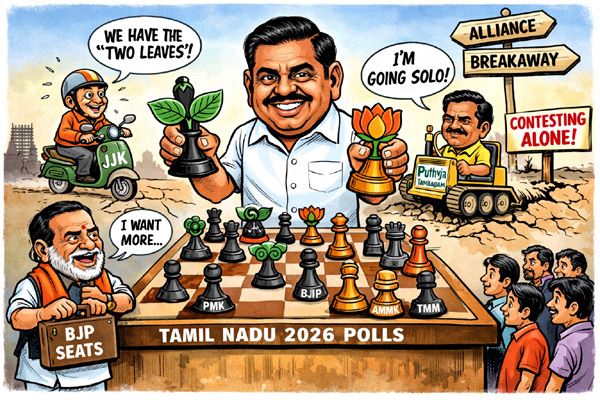
- Seat-sharing chessboard settles: Edappadi K. Palaniswami-led AIADMK anchors alliance with dominant share as BJP, PMK & others slot in
- Symbol tug-of-war: Allies juggle ‘Two Leaves’ & ‘Lotus’ amid reported friction over identity and visibility
- Candidate rush & ground buzz: Lists roll out, key constituencies heat up, big names in play across regions
- IJK & smaller allies step in: New faces announced, strategic placements signal micro-level calculations
- Spoiler in the South? K. Krishnasamy opts solo, eyes 70 seats to consolidate caste base
At the core stands Edappadi K. Palaniswami, whose party is contesting the lion’s share of seats—reportedly over 170—while allocating around 65 constituencies to allies including the Bharatiya Janata Party, PMK, AMMK, TMM, IJK, and others. The AIADMK has already released extensive candidate lists, signalling early groundwork and organisational readiness across the State.
Symbol Politics Sparks Alliance Undercurrents
Even as the alliance structure takes shape, a subtle tussle over electoral symbols has surfaced. Allies like the Indiya Jananayaka Katchi (IJK), led by Ravi Pachamuthu, announced candidates—Venkatesan (Pallavaram) and Saranya Anbazhagan (Kunnam)—and asserted they would contest under the AIADMK’s iconic ‘Two Leaves’ symbol.
Meanwhile, A. C. Shanmugam indicated a dual approach, stating his party would use the BJP’s ‘Lotus’ in one seat and ‘Two Leaves’ in another—reflecting the balancing act within the गठबंधन. Reports suggest AIADMK had reservations over smaller allies opting for the BJP symbol, which may have delayed seat-sharing consensus.
BJP’s Calculated Spread & Key Faces in Play
The BJP is expected to contest around 27 seats, with a focused presence in regions like Coimbatore, Kanyakumari, and select urban pockets. High-profile names including Nainar Nagendran, L. Murugan, and Tamilisai Soundararajan are likely to headline the party’s campaign.
However, reports indicate the party secured limited urban strongholds, with only one सीट in Chennai (Mylapore) and constrained allocations in Coimbatore—highlighting tough negotiations within the alliance framework.
Ground-Level Momentum Builds Across Constituencies
From the Cauvery delta to western belts and southern districts, the AIADMK’s expansive candidate rollout—spanning seats like Coimbatore South, Tirunelveli, Madurai North, and Kanyakumari—signals a statewide push to reclaim political ground.
Simultaneously, smaller allies are being strategically positioned to maximise local influence, caste equations, and micro-level voter mobilisation.
Puthiya Tamilagam’s Solo Gamble Alters Equations
In a significant twist, Puthiya Tamilagam, led by K. Krishnasamy, has opted to go solo after failed negotiations with the AIADMK-led alliance.
The party plans to contest up to 70 seats, banking on its influence among the Devendra Kula Vellalar community across southern districts like Tirunelveli, Thoothukudi, Ramanathapuram, and Virudhunagar.
Krishnasamy asserted, “We work for marginalised communities, with strong bases in districts such as Tenkasi, Tirunelveli, Virudhunagar, Ramanathapuram, Madurai, Dindigul region, particularly in rural and semi urban areas. The party has campaigned against five years of DMK misrule… Talks with AIADMK and NDA partners stalled due to minimal seat offers, so the party is preparing to contest the 2026 assembly elections independently. Candidate applications are being collected, with final decisions to follow.”
He also underscored the party’s support base, stating it represents “more than one crore Devendra Kula Vellalar people,” and cited lack of “due political recognition” as a key reason for the break.
Big Picture: Alliance Strength vs Fragmentation Risks
With polling scheduled for April 23 and counting on May 4, the AIADMK-led NDA enters the fray with organisational depth and a broad alliance canvas. Yet, symbol disputes, constrained seat allocations, and the emergence of independent players like Puthiya Tamilagam inject an element of unpredictability.
As campaign momentum builds, Tamil Nadu’s electoral battlefield is poised for a contest where alliances may decide scale—but local dynamics could dictate the outcome.