NE DEFENCE BUREAU
NEW DELHI/MUNICH, APR 23
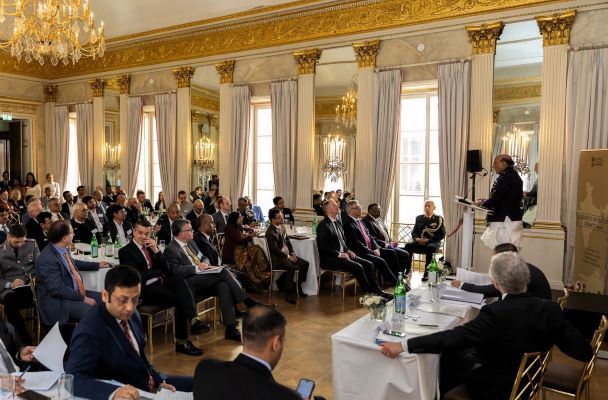
Making a strong pitch for strategic collaboration, Defence Minister Rajnath Singh invited German industry leaders to co-develop and co-produce advanced defence technologies with India, underscoring the need for trusted partnerships in an increasingly uncertain global landscape.
Raksha Mantri Shri @rajnathsingh urged German industry to co-develop & co-produce niche defence technologies with India at the Defence Investor Summit in Munich. Emphasised trusted partnerships as key amid global uncertainties, highlighting India’s stable ecosystem, skilled… pic.twitter.com/cpnhpQZgRT
— Ministry of Defence, Government of India (@SpokespersonMoD) April 23, 2026
Addressing Indian and German defence industry captains at the Defence Investor Summit in Munich on April 23, Singh emphasised that partnerships rooted in reliability and shared interests are now critical.
“Partnerships based on reliability & shared interests are indispensable amid increasing global uncertainties.”
- Defence Minister Rajnath Singh pitches co-development in niche tech at Munich summit
- Calls for “reliable partnerships” amid global supply chain shifts and geopolitical churn
- Positions India as stable, innovation-driven hub with skilled talent and policy certainty
- Defence ties deepen with Germany through roadmap pacts and submarine tech engagement
Highlighting shifting geopolitical alignments, supply chain disruptions and rapid technological change, the Defence Minister noted that nations and industries are rethinking dependencies and seeking resilient, long-term collaborations.
He positioned India as a compelling destination for such partnerships:
“India offers expanding market, skilled workforce & evolving industrial ecosystem with stability, predictability & commitment to the rule of law; It’s not short-term opportunity, but long-term strategic proposition.”
Pointing to opportunities under initiatives like ReArm Europe and Aatmanirbhar Bharat, Singh said Indian firms are keen to collaborate with German companies in cutting-edge areas such as advanced radar and sensor systems, AI-enabled unmanned platforms, multi-sensor technologies, sonobuoys and high-power low-frequency underwater transmitters.
Reframing India’s self-reliance vision, he stressed that it is anchored in collaboration—not isolation:
“India’s self-reliance pursuit is not inward-looking, we see it as the ability to design, develop & produce with trusted partners.”
He elaborated that India is transitioning from being merely a buyer of defence equipment to becoming a co-creator in design, development and manufacturing—opening new avenues for global industry participation.
“We are moving towards a model where India is not merely a buyer of defence equipment, but a partner in design, development, and production… This is not a short-term opportunity. It is a long-term strategic proposition.”
Underscoring the role of defence in India’s growth story, Singh said a robust industrial base is central to national security, economic resilience and global competitiveness, driven by collaboration among industry, academia and start-ups.
He also highlighted policy reforms aimed at improving ease of doing business, stating:
“Our policies are transparent, predictable, and investor-friendly. We have liberalised our norms, strengthened our regulatory frameworks, and invested heavily in infrastructure.”
On bilateral ties, the Defence Minister noted the growing convergence between India and Germany in building resilient defence supply chains.
“Both nations are aligning their industries to create resilient supply chains for defence equipment, particularly in response to geopolitical shifts.”
During the visit, Singh held bilateral talks with German Defence Minister Boris Pistorius in Berlin, where both sides advanced strategic cooperation through the Defence Industrial Cooperation Roadmap and agreements on UN peacekeeping training.
He also visited the Thyssenkrupp Marine Systems (TKMS) submarine facility in Kiel, exploring collaboration in advanced naval technologies aligned with India’s modernisation priorities.
Looking ahead, Singh expressed confidence in a deeper partnership:
“If the earlier chapters of India-Germany partnership were written through technology, enterprise, and culture, the next chapter can be written through innovation, capability, and strategic cooperation.”