

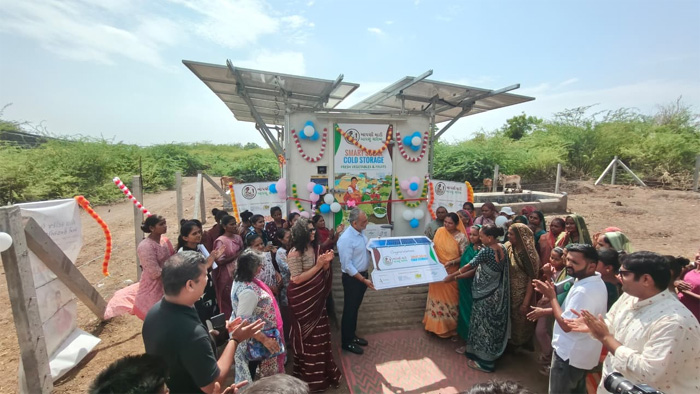
Ridhish Patel, Chairman & Managing Director, ArMee Infotech Limited, interacts with women producer-company members during the launch of the solar-powered rural enterprise initiative.- NE photo
- Climate-smart, community-owned solar infrastructure empowers women farmers to transform agricultural value chains and rural livelihoods
- Twin solar cold storage facilities in Bhavnagar and Rajula tackle post-harvest losses while unlocking higher income opportunities
- Women-led producer companies emerge as rural entrepreneurs, creating a replicable model of self-reliance, sustainability and local enterprise
- Partnership-driven initiative blends renewable energy, agricultural innovation and grassroots ownership to strengthen climate resilience
WOMEN EMPOWERMENT BUREAU
RAJKOT, JUNE 5, 2026
In a powerful example of how sustainability, technology and women’s leadership can reshape rural economies, ArMee Infotech Limited has enabled the creation of two community-owned solar cold storage enterprises in Gujarat, opening new pathways for income generation, climate resilience and agricultural prosperity.
The initiative has been implemented under the Soil to Sustainability – Aapdi Maati, Aapdu Bhavishya programme by WAY Everything Connects Foundation (WAY Foundation), in collaboration with the Centre for Environment and Social Concerns (CESC) and Farmfluence AgriTech.
The two solar-powered facilities, each with a storage capacity of five metric tonnes, were inaugurated this week in Bhavnagar and Rajula. Designed to reduce post-harvest losses and strengthen market access for smallholder farmers, the units are expected to help farming communities preserve produce for longer durations, improve price realisation and enhance overall agricultural profitability.
More importantly, the project goes beyond infrastructure creation. It seeks to establish financially sustainable rural enterprises owned, managed and operated by women-led producer companies, creating a model where renewable energy and community entrepreneurship work together to drive economic empowerment.
Following a statewide application and assessment process conducted by WAY Foundation, two women-led producer collectives were selected to receive the facilities.
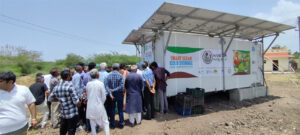
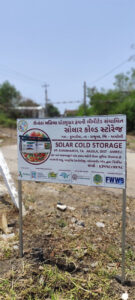
The solar cold storage unit at Utthan Mahila Producer Company Limited, Bhavnagar, was inaugurated on June 2, while the facility at Utkantha Mahila Producer Company Limited, Rajula, supported by Friends of Women’s World Banking (FWWB), was inaugurated on June 3.
The inauguration ceremonies witnessed participation from women farmers, producer company representatives, development partners, community leaders and local stakeholders, underscoring the collaborative spirit behind the initiative.
Speaking on the occasion, Ridhish Patel, Chairman & Managing Director, ArMee Infotech Limited, said: “Sustainable development creates the greatest impact when communities become owners rather than beneficiaries. These solar cold storage facilities are not merely storage infrastructure; they are intended to become women-led rural enterprises capable of generating income, creating local employment, reducing agricultural wastage, and strengthening rural economies. Our vision is to create a replicable model where renewable energy, entrepreneurship, and community ownership come together to drive long-term prosperity and self-reliance.”
To ensure the long-term viability of the enterprises, the partner organisations have jointly announced a Business Model Development Workshop in Ahmedabad for participating producer companies.
The workshop will focus on enterprise management, governance practices, market linkage development, revenue generation strategies, operational planning and long-term sustainability frameworks aimed at strengthening the business capabilities of the women-led organisations.
Commenting on the initiative, Wricha Johari, Co-Founder, WAY Foundation, said: “The long-term success of community-owned agricultural infrastructure depends not only on technology adoption but also on building strong and sustainable local enterprises. Through this initiative, we aim to equip women-led producer companies with the knowledge, systems, and business capabilities required to operate successful enterprises that are aligned with local agricultural practices, market opportunities, and community needs.”
The project reflects a larger vision of fostering climate-smart agriculture, renewable energy adoption, women entrepreneurship and resilient rural livelihoods. It also showcases how meaningful partnerships among corporates, development organisations and community institutions can create scalable models for inclusive and sustainable rural transformation.
As Gujarat’s rural communities navigate the challenges of climate change and agricultural volatility, the initiative offers a blueprint for a future where women are not merely participants in development—but architects of prosperity, sustainability and economic resilience.