- Defence Minister urges industry to transform regional strengths into national capabilities, innovation into global competitiveness and manufacturing into strategic power
- Says self-reliance is about engaging the world from a position of strength, not economic isolation, while championing technology partnerships and joint ventures
- Highlights India’s defence production surge to ₹1.78 lakh crore and record exports of ₹38,424 crore as proof of the country’s manufacturing transformation
- Projects Gujarat as India’s next defence and semiconductor powerhouse, leveraging its industrial ecosystem, skilled workforce and world-class infrastructure
- Vibrant Gujarat Regional Conference witnesses industry interactions, exhibition visits and MoU exchanges to accelerate investment, innovation and strategic growth
NE BUSINESS BUREAU
VADODARA, JUNE 30
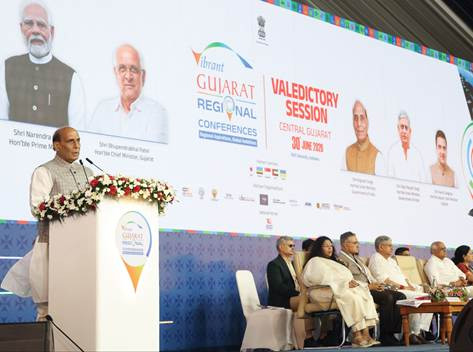
Calling upon industry to become a driving force behind India’s transformation into a developed nation, Defence Minister Rajnath Singh on Tuesday urged regional enterprises to align their strengths with the national vision of Viksit Bharat @2047, asserting that local innovation and industrial excellence must evolve into strategic national capabilities.
Addressing industrialists, entrepreneurs, innovators and academicians at the Vibrant Gujarat Regional Conference in Vadodara, Rajnath Singh said: “Viksit Bharat is not merely a goal of economic development, but a resolve to build an economically prosperous, technologically capable, and socially empowered country. Regional industries must become partners in this journey by transforming regional strengths into national capabilities, local innovations into global competitiveness, and industrial growth into strategic strength.”
The conference was attended by Gujarat Chief Minister Bhupendra Patel, Union Minister Rajiv Ranjan Singh, Gujarat Minister Manisha Vakil, senior government officials, industry leaders and representatives from academia.
Economic Strength, Technology and National Security Go Hand in Hand
Emphasising the changing geopolitical landscape, the Defence Minister said India’s future global standing would depend on its ability to integrate economic growth, technological advancement and national security.
“History teaches us that great nations stand on three essential pillars: economic strength, technological prowess, and national security. Economic prosperity and technological advancement reinforce national security, while a secure nation provides the stability that allows industry and innovation to flourish.”
He stressed that defence manufacturing extends far beyond weapons production, acting as a catalyst for infrastructure development, logistics, advanced manufacturing, research, innovation, employment generation and industrial growth.
India’s Defence Manufacturing Story Rewritten
Highlighting the transformation witnessed over the past decade, Rajnath Singh said India has moved decisively from being one of the world’s largest defence importers to becoming an emerging global defence manufacturing and export hub.
He noted that indigenous platforms, expanding private-sector participation, start-up innovation and supportive government policies have collectively created a vibrant defence ecosystem.
“Under Aatmanirbhar Bharat, we are fostering indigenous capabilities in strategic sectors such as aerospace and defence. Make in India, reforms in the Defence Acquisition Procedure, the Technology Development Fund, iDEX, Srijan Portal, Defence Testing Infrastructure, Green Channel Certification and simplified licensing have created an ecosystem where innovation, industry and self-reliance converge to strengthen the security of New India.”
Defence Minister highlighted the remarkable growth in India’s defence sector, stating that domestic defence production has risen from ₹46,000 crore in 2014 to a record ₹1.78 lakh crore, while defence exports have surged from less than ₹1,000 crore to an all-time high of ₹38,424 crore.
Self-Reliance Means Global Competitiveness
Clarifying the government’s approach towards self-reliance, Rajnath Singh said:
“Self-reliance does not mean isolation. It signifies a nation standing firmly on its own feet and engaging with the world as an equal partner.”
He added that India continues to encourage collaborations with global Original Equipment Manufacturers (OEMs), technology transfers and joint ventures to strengthen indigenous manufacturing while integrating domestic industries into global value chains.
Gujarat Poised to Become India’s Defence Innovation Hub
Describing Gujarat as one of the country’s most promising industrial growth engines, the Defence Minister said the state’s manufacturing capabilities, entrepreneurial culture and skilled workforce position it to play a defining role in India’s defence ecosystem.
He cited the Tata-Airbus C-295 aircraft manufacturing complex in Vadodara and the production of the K-9 Vajra self-propelled artillery system in Gujarat as examples of the state’s growing strategic importance.
He also underlined Gujarat’s emergence as India’s semiconductor hub through projects in Sanand and Dholera, stating that chips would become the backbone of future warfare and the digital economy.
“From artificial intelligence to quantum computing, and from cybersecurity to space technology, this ecosystem in Gujarat will strengthen us across every sector.”
Rajnath Singh further observed that Gujarat’s strengths in chemicals, petrochemicals, electronics, shipbuilding, ports, renewable energy and green hydrogen provide a complete ecosystem for advanced defence manufacturing.
“The state possesses the complete ecosystem required for a defence manufacturing hub. I am confident that the youth and entrepreneurs of Gujarat will strive to achieve this endeavour.”
Industry Engagement and Strategic Partnerships
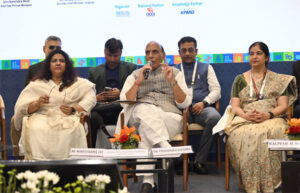
During the conference, the Defence Minister interacted with industrialists, business leaders, start-ups and academia during a dedicated seminar on defence and aerospace manufacturing, reiterating the government’s commitment to creating a business-friendly ecosystem that promotes innovation, investment and technology-led growth.
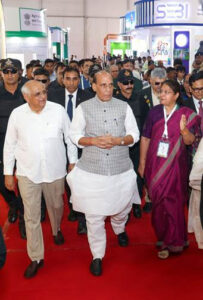
He also visited an extensive exhibition showcasing products and innovations from MSMEs, start-ups, defence companies, automobile manufacturers, exporters, women entrepreneurs, tribal artisans, mobility innovators and heavy industries.
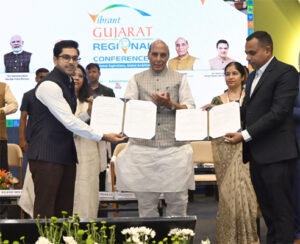
The event also witnessed the exchange of several Memoranda of Understanding (MoUs) aimed at accelerating industrial investment, technological collaboration and regional economic development under the broader vision of Viksit Bharat @2047 and Viksit Gujarat @2047.