- Three-week induction programme puts AI, renewable energy, innovation and responsible leadership on the learning map for freshers
- Tech and integrated-programme students gain exposure to leading academicians, industry leaders and emerging technologies
- Bridge courses, mentoring and campus immersion help students make the crucial transition from school to university with confidence
- Experts from IITs, NITs, industry and global consulting firms challenge young learners to think critically, innovate responsibly and keep learning beyond the classroom
NE EDUCATION BUREAU
AHMEDABAD, AUG 2
Engineering education begins where the textbook ends. For a new generation of engineers entering a world shaped by artificial intelligence, renewable energy, rapid technological disruption and complex social challenges, the first lesson may well be that a degree alone is not enough.
Seeking to prepare students for precisely that reality, Adani University has concluded a three-week Induction Programme 2026 for students joining its Bachelor of Technology (B.Tech.) and Integrated Programmes, combining academic preparation with industry exposure, technology insights, mentoring and leadership orientation.
Held from July 13 to July 31, the programme was designed to ease the transition from school to university while giving freshers an early glimpse of the rapidly changing engineering and technology landscape.
When engineering meets the real world
Provost Prof. (Dr.) Dhaval Pujara, Adani University, said the purpose of induction went beyond simply familiarising students with a new campus.
“University is where knowledge begins to find real-world application. Through this induction programme, students were introduced to new ideas, emerging technologies and the importance of learning beyond the classroom,” he said.
“Our goal is to help them develop into engineers who think critically, innovate responsibly and use their knowledge to solve real-world challenges,” Pujara added.
That philosophy shaped the three-phase programme, which brought together foundation courses, expert lectures and campus-based activities.
The induction began with an online Bridge Course in Mathematics, Physics and Communication Skills, helping students strengthen core competencies before beginning their formal university curriculum.
AI, green energy and the technology frontier
A week-long online programme subsequently brought students into interaction with academicians and experts, including Prof. Kavi Arya of IIT Bombay, Dr. Soukat Kumar Das of NIT Rourkela, Dr. Rishabh Abhinav of PSE2 Consulting, UK, Prof. Nigam of Pandit Deendayal Energy University and Dr. Kaustav Bakshi of IIT Indore.
The sessions exposed students to subjects at the heart of the emerging engineering ecosystem, including artificial intelligence, renewable energy, engineering innovation, research and emerging technologies.
The emphasis was significant: rather than viewing engineering as a collection of disciplines, students were encouraged to understand how technology intersects with energy, industry, research and society.
From technology to leadership
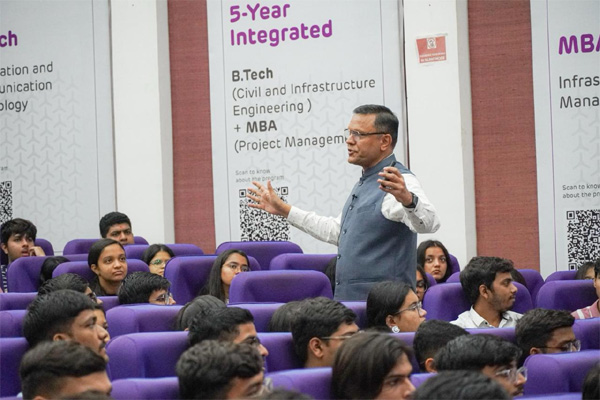
The on-campus phase added an industry and leadership dimension.
Students interacted with Arun Bansal, Chief Executive Officer, Adani Airport Holdings Limited; Jigish Doshi, Chairman, Vishakha Group; and Ajay Kumar Tomar, Joint President & Group Head, Cadre Excellence and Leadership Development, Adani Group.
Their interactions focused on leadership, innovation, resilience and lifelong learning, giving students perspectives from industry that complement formal academic instruction.
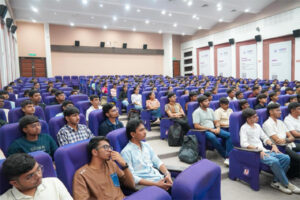
Mentoring sessions, team-building activities and interactions with the University’s leadership further sought to build confidence, communication and collaborative skills among the freshers.
The underlying message was clear: tomorrow’s engineer will need more than technical competence.
Building responsible engineers
The programme also introduced students to the University’s academic and research ecosystem, examination systems, digital learning platforms, competency-development initiatives and student-support services.
Importantly, orientation was not confined to academics.
Students were briefed on anti-ragging measures, the Prevention of Sexual Harassment (POSH) policy and responsible use of social media, reinforcing the importance of safety, dignity, ethics and responsible conduct within the university community.
In that sense, the induction served as an early introduction to the responsibilities that accompany professional education.
The three-week programme ultimately sought to establish a foundation on which students can build not merely careers, but the ability to question, innovate, collaborate and apply knowledge to real-world problems.
As engineering itself undergoes a profound transformation, the challenge for universities is no longer simply to produce technically qualified graduates. It is to prepare young minds for a world where technologies change rapidly, disciplines increasingly overlap and solutions must be both innovative and responsible.
At Adani University, the message to the new batch was unmistakable: the journey from student to engineer begins not with the first examination, but with the willingness to look beyond the classroom.