- 13 Gold, 17 Silver, 9 Bronze as India conquers trimmed-down Glasgow Games with fighting spirit
- Boxing leads charge with record 10-medal haul; India finishes fourth despite traditional medal sports missing
- PM Modi hails athletes’ “exceptional skill, determination and dedication”
- Glasgow baton passes to Ahmedabad as Gujarat prepares for the Centenary Commonwealth Games in 2030
NE SPORTS BUREAU
NEW DELHI, AUG 3
From the roar of the boxing ring to the grit of para-athletics, India has left Glasgow with its sporting flag flying high—39 medals, 13 of them gold, and a fourth-place finish at the 2026 Commonwealth Games. More than a medal count, the campaign has offered a glimpse of a deeper, wider Indian sporting bench, achieved in a dramatically reduced Games programme that left several of the country’s traditional medal-rich disciplines outside the competition.
India’s final haul comprised 13 gold, 17 silver and nine bronze medals, placing it fourth behind Australia, England and Canada. Australia dominated the table with 171 medals, including 70 gold, followed by England with 110 and Canada with 62.
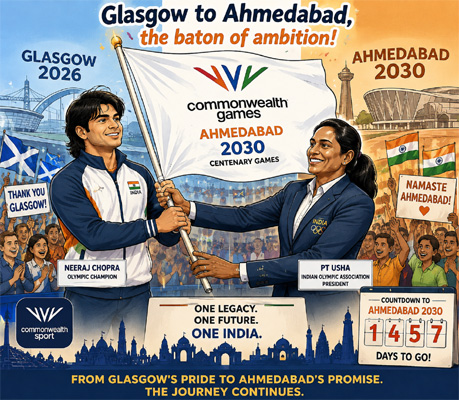
And as the Glasgow chapter closed, another Indian sporting story opened: the Commonwealth Games flag and ceremonial baton were formally handed over to India, with Olympic champion Neeraj Chopra and Indian Olympic Association president PT Usha receiving them—setting the countdown running towards Ahmedabad 2030.
39 medals from a trimmed-down battlefield
The context makes India’s fourth-place finish particularly significant.
Glasgow 2026 featured only 10 sports, with several disciplines in which India has traditionally excelled—including wrestling, badminton, shooting and hockey—not part of the programme. Yet India improved its medal haul in the comparable disciplines from 30 at Birmingham 2022 to 39 in Glasgow, according to Union Sports Minister Mansukh Mandaviya.
“Despite Glasgow 2026 being a trimmed-down edition without several disciplines where India traditionally excels, Team India improved from 30 medals in the comparable disciplines at Birmingham 2022 to 39 medals this year,” Mandaviya said.
“Under the leadership of Prime Minister Shri Narendra Modi Ji, the growing depth and strength of Indian sport is clearly visible,” he added.
The minister saluted the entire support ecosystem, saying: “Proud of every athlete, coach and support staff who gave their all for the Tricolour.”
The medal rush was particularly emphatic in boxing, where India produced a record 10-medal haul, including seven golds, its best performance in the sport at a Commonwealth Games. Judo, weightlifting, athletics and para-athletics also contributed to a campaign that showcased a broader spread of Indian medal potential.
Modi: ‘Proud of our contingent’s performance’
Prime Minister Narendra Modi celebrated the Glasgow campaign and congratulated every medal winner.
“Proud of our contingent’s performance at the Glasgow Commonwealth Games. Delighted that India has won 39 medals, including 13 Golds,” Modi wrote on X.
He praised the athletes’ competitive spirit, saying: “Throughout the Games, our talented athletes have displayed exceptional skill, determination and dedication. Their hardwork will keep inspiring our youngsters.”
Extending his wishes to the contingent, the Prime Minister expressed hope that the athletes would continue to bring greater glory to the country.
The achievement also acquires added significance because India has retained a top-four position despite competing in a substantially curtailed sporting programme. The 39-medal haul is therefore not merely a numerical success; it is an indicator of the depth emerging beyond India’s traditional Commonwealth strongholds.
From Glasgow’s glory to Ahmedabad’s 2030 dream
For Gujarat, the Glasgow closing ceremony carried a special resonance.
The handover of the Commonwealth Games flag and baton to India has effectively launched the journey towards the Centenary Commonwealth Games in Ahmedabad in 2030. PT Usha, who received the flag alongside Neeraj Chopra, had earlier described the Ahmedabad edition as “Games for the Future”, built around sustainability, inclusivity and innovation.
Gujarat Chief Minister Bhupendra Patel has already outlined a wider legacy vision for the 2030 Games, with international-standard sports facilities, better public transport and improved air quality among the state’s priorities. His stated aim is to leave behind infrastructure that “continues to improve everyday urban life long after the games.”
Patel has also described the 2030 Games as a major opportunity for Gujarat and India, stressing the potential of world-class infrastructure, connectivity and organisational capacity to create a memorable sporting spectacle.
Deputy Chief Minister Harsh Sanghavi, who also handles Sports and Culture, has positioned Gujarat’s preparations within a broader ambition to nurture athletes and establish world-class sporting infrastructure. He has described Ahmedabad’s 2030 opportunity as a moment of immense pride and emphasised the state’s commitment to “Sports for All, Sports for Excellence.”
Gujarat’s preparations are already moving beyond the drawing board. Commonwealth Sport officials have undertaken venue inspections and reviewed infrastructure, logistics and planning for the 2030 edition.
THE MEDAL TALLY — GLASGOW 2026
| Rank | Country | Gold | Silver | Bronze | Total |
| 1 | Australia | 70 | 54 | 47 | 171 |
| 2 | England | 36 | 40 | 34 | 110 |
| 3 | Canada | 20 | 21 | 21 | 62 |
| 4 | India | 13 | 17 | 9 | 39 |
India’s 39-medal tally equals Scotland’s overall haul, while the fourth-place finish provides a strong platform for the country’s sporting ecosystem to build upon ahead of the 2030 home Games.
The Glasgow campaign is over. But for India, the next starting gun has already sounded.
From a 39-medal finish in Glasgow to a home Games in Ahmedabad, the road to 2030 now begins—with a nation expecting not merely to host the Commonwealth, but to redefine its sporting ambition.