R ARIVANANTHAM
CHENNAI, AUG 4
When political rhetoric descends from challenging an opponent’s policies to dragging a woman’s name and dignity into the arena, where should the line be drawn? The detention of Tamil Nadu Opposition Leader Udhayanidhi Stalin over an allegedly double-meaning remark involving actor Trisha has transformed what began as a political exchange at a Cauvery protest into a much larger debate over decency in public speech, women’s dignity and the responsibility that comes with a powerful political microphone.
- Udhayanidhi detention puts spotlight on political decency and the dignity of women
- Cauvery protest rhetoric triggers police action, TVK complaint and National Commission for Women intervention
- Across party lines, bigger question emerges: Can political combat ever justify humiliating a woman?
- DMK defends its leader as opponents demand accountability; activists seek a higher standard of public discourse
- Thiruvalluvar’s timeless warning: when better words exist, why choose hurtful ones?
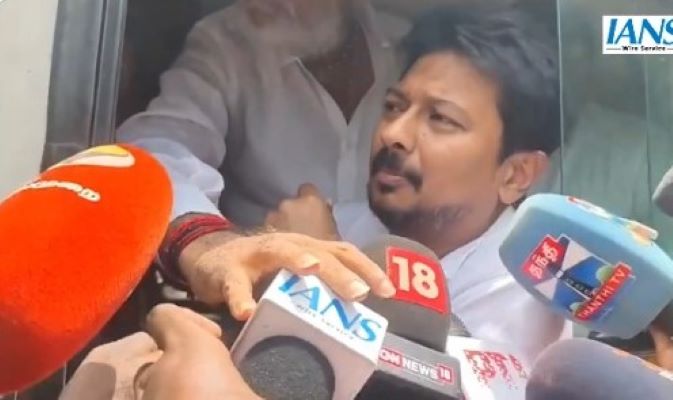
Udhayanidhi was taken into police custody from his Chennai residence on Tuesday for questioning in connection with the controversial remark made during a DMK farmers’ protest in Thanjavur on August 3. The controversy erupted after sections of the gathering reportedly chanted Trisha’s name and Udhayanidhi responded with a remark that critics described as vulgar and sexually suggestive. He has questioned the basis of the action and disputed the interpretation of his words.
The ruling Tamilaga Vettri Kazhagam (TVK) has lodged a police complaint and approached the National Commission for Women (NCW) seeking action. Reports say the complaint invokes provisions including the Tamil Nadu Prohibition of Harassment of Women Act.
But beyond the political duel between the DMK and TVK, the episode raises a question that should concern every political party: Does a woman cease to deserve dignity because she is an actor, public figure or happens to be associated—fairly or unfairly—with a political rival?
A woman’s profession cannot be a licence for humiliation
The issue is not whether political leaders can criticise one another. They can—and must—when governance, corruption, public policy or political conduct is at stake.
The issue is how far that criticism can go.
Cinema may be a public profession, but being an actor does not surrender a woman’s right to dignity. Nor should her name be converted into a political prop, a crowd-puller or an insinuation in a public speech.
Women activists and civil-society voices have increasingly argued that the standard must be universal: no woman should be sexualised, objectified or reduced to innuendo because she is a celebrity, actor, politician, journalist, sportsperson or member of the public.
That principle must apply irrespective of political affiliation.
Equally, political parties cannot demand respect for women when their opponents make objectionable remarks and remain silent when similar language comes from their own ranks. The test of a party’s commitment to women’s dignity is consistency.
The present controversy is therefore bigger than Udhayanidhi or Trisha.
It is about whether Tamil Nadu’s political discourse is becoming so accustomed to personal attacks that decency itself is being treated as political weakness.
DMK’s defence, TVK’s counter: Politics takes centre stage
The DMK has rejected the interpretation being placed on Udhayanidhi’s remarks.
Party spokesperson TKS Elangovan defended him, saying that people were “twisting” the speech and asserting that it did not contain derogatory or insulting comments.
Udhayanidhi himself has questioned the action against him, asking, “Did I say anything wrong?”, according to reports, while his camp has described the case as politically motivated.
DMK MP Kanimozhi, meanwhile, attacked the arrest itself, describing it as “blatant cowardice” and alleging political motivation behind the action.
That is an important part of the story and cannot be ignored.
At the same time, the argument over whether the police action is proportionate or politically motivated should not obscure the separate question of whether public figures should exercise greater restraint before using words that can demean women.
Both questions can—and should—be debated independently.
TVK’s complaint and the test of equal accountability
The TVK government, which has formally complained to the NCW, has framed the issue as one requiring action against objectionable remarks concerning a woman. The complaint has added a legal dimension to what could otherwise have remained another ugly episode in Tamil Nadu’s increasingly combative political rhetoric.
Yet this, too, presents a test for the ruling establishment.
If the government insists on accountability from an Opposition leader, the same standard must apply to ministers, ruling-party functionaries, allies and supporters whenever women are subjected to degrading or sexualised language.
There can be no selective morality.
Tamil Nadu’s political history has seen objectionable comments about women from multiple political camps. Earlier this year, remarks involving actor Nayanthara triggered a similar controversy, with DMK MP Kanimozhi saying that vulgarising women for political attacks was unacceptable and reflected a regressive mindset.
The lesson should be obvious: a political party cannot demand dignity for women only when the woman happens to be on its side.
Thirukkural’s lesson for today’s political stage
Tamil Nadu does not have to search far for a philosophy of restraint.
More than two millennia ago, Thiruvalluvar put the ethics of speech into a single memorable couplet:
“இனிய உளவாக இன்னாத கூறல்
கனியிருப்பக் காய்கவர்ந் தற்று.”
In essence: When pleasant words are available, choosing hurtful words is like leaving ripe fruit and choosing the unripe. (Thirukkural)
That is not a call for political timidity.
It is a call for political maturity.
A leader can demolish an opponent’s argument without demolishing the opponent’s dignity. A politician can expose a government’s failure without dragging a woman’s personal life or profession into the debate. A speaker can electrify a crowd without resorting to sexual innuendo.
Indeed, the ability to restrain language when the crowd is demanding provocation may be the truest test of leadership.
Activists’ message: Women are not political ammunition
Women’s rights advocates say the controversy should prompt political parties to evolve a common code of conduct for public speeches, particularly when women are referred to.
The message is straightforward: Women are not political ammunition.
An actor is not merely a body to be discussed. A woman politician is not an acceptable target for sexualised insults. A journalist cannot be demeaned for asking uncomfortable questions. A sportsperson cannot be objectified because she is famous. A woman activist does not surrender dignity by entering public life. The same principle must apply to women across professions and social backgrounds. And it must apply equally to the ruling party and the Opposition.
The growing demand is therefore not simply for punishment after an offensive remark but for a culture of restraint before the remark is made.
Political speech needs a new standard of dignity
The Udhayanidhi episode comes at a politically sensitive moment in Tamil Nadu, where the DMK and the newly empowered TVK are engaged in an increasingly sharp contest for political space. That rivalry will inevitably produce fierce criticism.
But fierce need not mean filthy.
Democracy thrives on argument, dissent and satire. It becomes poorer when debate is replaced by personal humiliation.
The immediate legal questions surrounding the complaint, detention and any subsequent proceedings will have to be decided by the appropriate authorities and courts. The political questions will be contested in the Assembly and on the streets.
But one principle should remain beyond partisan politics:
No woman’s dignity should become collateral damage in a political battle.
And no party should need a police complaint, a court proceeding or a political controversy to rediscover what Tamil literature taught generations ago—that words may be weapons, but responsible leaders know when not to fire them.
For Tamil Nadu’s political class, the current controversy offers an opportunity to draw a line—not merely around what is legally punishable, but around what is morally unworthy of public life.