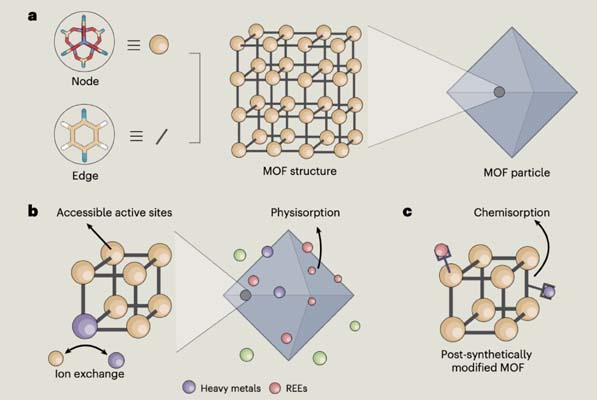
- IIT Gandhinagar, Cambridge and Birmingham researchers develop a metal-organic framework protocol to capture toxic metals from contaminated water
- The same approach could recover high-value rare-earth elements from e-waste and other complex waste streams
- Copper-based MOF recorded adsorption capacities of up to 490 mg/g for lead and more than 300 mg/g for several rare-earth elements
- Researchers test the protocol under challenging conditions, including alkaline wastewater, artificial seawater and e-waste-derived samples
- The approach seeks to move water treatment beyond pollution removal towards recovery, reuse and a circular-resource model
- Researchers caution that scale-up, cost, life-cycle assessment and regulatory testing will be critical before wider deployment
NE SCIENCE & TECHNOLOGY BUREAU
GANDHINAGAR, SEPT 30
What if the wastewater we treat as a pollution problem could also become a mine for critical minerals?
That possibility is at the heart of a new collaborative study by researchers from IIT Gandhinagar, the University of Cambridge and the University of Birmingham, who have developed a protocol using highly porous metal-organic frameworks (MOFs) to tackle two seemingly different challenges at once: removing toxic heavy metals from contaminated water and recovering valuable rare-earth elements from waste streams.
Published in Nature Protocols, the research offers a framework for designing, characterising and deploying MOFs under conditions that move beyond idealised laboratory settings. The approach could help push water treatment towards a more circular model—where contaminants are not merely removed and discarded, but valuable materials are recovered for potential reuse.
When waste becomes a resource
A broken phone, discarded earphones or an obsolete camera may appear worthless. Yet such electronic products can contain rare-earth elements (REEs) including neodymium, yttrium and dysprosium—materials crucial to technologies ranging from magnets and optics to batteries and other advanced applications.
The difficulty begins when these materials enter complex waste streams and contaminated water.
At the same time, industrial activities can release potentially toxic metals such as lead, cadmium, nickel and manganese into water. Conventional treatment therefore faces a dual challenge: remove harmful pollutants while, where feasible, recovering strategically valuable elements.
The researchers’ MOF-based protocol is designed to address both.
A molecular fishing net
MOFs can be imagined as an extraordinarily sophisticated molecular fishing net. Their enormous network of pores provides a vast internal surface, while chemically engineered sites can be tailored to interact preferentially with specific metals.
Some MOFs can possess internal surface areas of up to 7,000 square metres per gram—meaning that a tiny quantity of material can contain an internal surface area comparable to a football field.
That makes them attractive as adsorbents, materials capable of attracting and holding substances on their surfaces.
Traditional techniques such as precipitation, coagulation and flocculation remain important in water treatment, but can involve pH-sensitive processes, substantial infrastructure and the generation of sludge requiring further handling and disposal. Electrochemical approaches, meanwhile, can involve significant economic and environmental costs.
Adsorption offers another route, particularly where contaminants occur at relatively low concentrations. By tailoring the surface chemistry, researchers can seek greater affinity for specific target metals, while the adsorbent may potentially be regenerated and reused.
The numbers that stand out
The researchers evaluated the protocol under complex conditions, including alkaline wastewater at around pH 8.5, turbid water containing high levels of dissolved solids, artificial seawater and e-waste-derived samples.
The results from the copper-based MOF were particularly notable.
“For me, the most interesting aspect was observing the MOF in our protocol demonstrate substantial adsorption capacities,” said Dhruv Menon, a BTech graduate of IIT Gandhinagar and currently a doctoral student in the Department of Chemical Engineering and Biotechnology at the University of Cambridge.
He added: “The experiments showed that one gram of the copper-based MOF could capture nearly half a gram of lead (490 mg/g), and roughly a quarter of a gram each of cadmium (264 mg/g) and manganese (226 mg/g). For rare-earth elements, it could capture around one-third of a gram per gram of material (351 mg/g of neodymium, 343 mg/g of yttrium, 335 mg/g of dysprosium, 337 mg/g of terbium and 345 mg/g of europium).”
The figures point to a central attraction of the approach: the same materials platform can be explored for both environmental remediation and resource recovery.
From lab bench to real water
Real industrial effluents rarely contain a single contaminant. Wastewater from manufacturing, mining and chemical processing can contain multiple metals alongside pesticides, detergents and organic pollutants.
The protocol therefore incorporates testing in more challenging matrices rather than relying exclusively on simplified laboratory solutions.
The researchers emphasise that the workflow can also be adapted to similar adsorbents and other contaminants, potentially broadening its application across different waste streams.
The scale-up question
For Prof Superb Misra, Jibaben Patel Chair Professor in the Department of Materials Engineering at IIT Gandhinagar and Principal Investigator at the Bio Nano Materials Group, the larger significance lies in tackling environmental challenges simultaneously.
“There is a need for approaches that can solve multiple environmental challenges simultaneously. Our focus was on engineering the performance of MOFs to employ them for environmental remediation applications,” he said.
But he also stressed the limitations of laboratory studies.
“That said, it is crucial to understand that controlled batch experiments cannot fully predict behaviours in complex wastewater. There is a need to look at factors like large-scale fabrication, cost analyses, MOF life-cycle assessment and regulatory testing,” Misra added.
That caveat could prove crucial. Turning an impressive laboratory material into a commercially viable water-treatment technology will require not only performance, but affordable manufacturing, durability, regeneration, safe handling and compliance with environmental regulations.
Towards a circular critical-mineral economy
The research comes as India seeks to strengthen domestic capabilities for recovering critical minerals from secondary resources such as e-waste and battery waste.
The work also resonates with the broader India-UK push for cooperation on sustainable recovery of critical minerals from end-of-life waste streams, while contributing to the objectives of SDGs 6, 9 and 12—clean water and sanitation, industry and innovation, and responsible consumption and production.
The wider research team includes Prathmesh Bhadane, Priya Mahato, Prateek Goyal, Dr Iseult Lynch and Dr Swaroop Chakraborty from the collaborating institutions.
The bigger idea is deceptively simple: clean the water, recover the metal and reduce what gets thrown away.
If the approach can ultimately overcome the challenges of scale, cost and regulation identified by the researchers, wastewater treatment could increasingly become more than an exercise in removing pollution—it could become another source of the critical materials needed for the technologies of tomorrow.