NE DEFENCE BUREAU
KOLKATA, JUNE 21
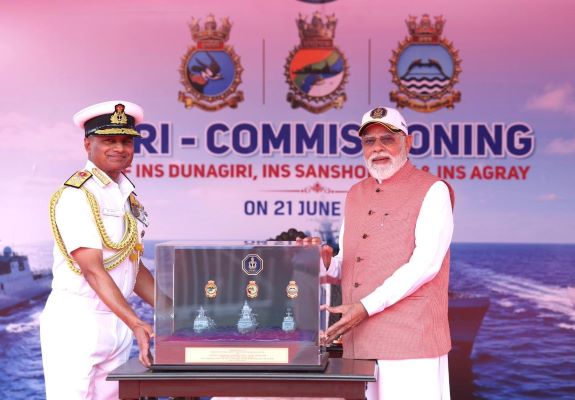
Declaring that “the country whose maritime strength is robust, its economic and strategic influence will be equally robust,” Prime Minister Narendra Modi on Sunday commissioned three state-of-the-art frontline naval platforms—INS Dunagiri, INS Sanshodhak and INS Agray—into the Indian Navy at Kolkata, significantly strengthening the nation’s maritime security architecture and indigenous defence capabilities.
Today in Kolkata, INS Dunagiri, INS Sanshodhak and INS Agray were commissioned. They reflect India’s growing maritime capabilities, our commitment to safeguarding national interests across the seas and the remarkable strides being made towards self-reliance in defence… pic.twitter.com/hWyD7ePH2W
— Narendra Modi (@narendramodi) June 21, 2026
The landmark tri-commissioning marks another giant leap in India’s quest for self-reliance in defence manufacturing and maritime preparedness. The advanced platforms are expected to substantially enhance operational capability, underwater warfare preparedness, hydrographic excellence, maritime domain awareness and regional security in the Indian Ocean Region.
- INS Dunagiri, INS Sanshodhak and INS Agray inducted in Kolkata, marking a new milestone in Aatmanirbhar Bharat
- Prime Minister says maritime strength will define India’s economic, strategic and geopolitical influence
- Tri-commissioning showcases India’s growing self-reliance in warship design, construction and defence manufacturing
- Over 75% indigenous content and contributions from 200 MSMEs underline industrial transformation
- Platforms to boost combat readiness, hydrographic excellence, anti-submarine warfare and maritime domain awareness
- Defence Minister hails induction as a defining moment in India’s journey towards a secure Indian Ocean
Addressing a distinguished gathering, the Prime Minister described the occasion as a major milestone in the journey towards Aatmanirbhar Bharat, a secure India and a developed India.
A milestone for India’s maritime security! Speaking at the Tri Commissioning ceremony of INS Agray, INS Dunagiri and INS Sanshodhak in Kolkata. @indiannavy https://t.co/obmbDiY4T0
— Narendra Modi (@narendramodi) June 21, 2026
“The journey from INS Vikrant to today is not merely the journey of new warships, it is the journey of India’s growing self-reliance,” he said.
Highlighting the strategic importance of the maritime domain, Modi observed that no nation can emerge as a major global power without strong maritime capabilities.
“Development, security and prosperity are closely linked to the oceans. Most of the world’s trade moves through sea routes, while vast global data networks operate beneath the oceans,” he said, adding that critical minerals, deep-sea resources and future energy sources would increasingly shape global maritime competition.
The Prime Minister stressed that India is determined to move from being a defence importer to becoming a leading defence manufacturer.
“The strength of the nation’s military cannot be measured by its dependence on global markets but by its ability to become self-reliant. India seeks to become a producer and a manufacturer because nations that manufacture become decisive players on the global stage,” he asserted.
Modi pointed out that more than 40 indigenously built warships and submarines have been inducted into the Navy in recent years, while another 45 major naval platforms are currently under construction. He noted that India’s defence production has surged from nearly ₹40,000 crore in 2014 to around ₹1.8 lakh crore today.
Underscoring the maritime sector’s role as an economic growth engine, he said shipbuilding, ship repair and Maintenance, Repair and Overhaul (MRO) activities are now being viewed as part of a major national mission.
“The Government views the maritime sector not as an isolated industry but as a major engine of employment and economic growth for a developed India,” he said.
The three warships, designed by the Indian Navy and Garden Reach Shipbuilders & Engineers (GRSE), have been built with more than 75 per cent indigenous content and support from over 200 MSMEs, highlighting the strength of India’s expanding defence industrial ecosystem.
Defence Minister Rajnath Singh described the induction as a defining moment in India’s maritime capability development.
“These state-of-the-art platforms are a testament to our robust defence manufacturing ecosystem and our unwavering resolve towards Aatmanirbhar Bharat. They now stand ready to safeguard our national interests and ensure a secure Indian Ocean,” he stated.
Chief of the Naval Staff Admiral Krishna Swaminathan said the tri-commissioning, coming just 17 months after Independent India’s first such event, demonstrated that India’s warship-building capability is gaining fresh momentum through modern technology, self-reliance and confidence.
Among the three vessels, INS Dunagiri represents the cutting edge of indigenous combat capability as a stealth frigate equipped with advanced missiles, air-defence systems and anti-submarine warfare technologies. INS Sanshodhak strengthens India’s hydrographic and oceanographic capabilities, supporting the Blue Economy and Maritime Vision 2030, while INS Agray provides critical shallow-water anti-submarine and mine warfare capability.
Together, the three platforms reinforce India’s ability to undertake combat missions, humanitarian assistance and disaster relief operations, hydrographic surveys, maritime diplomacy and civilian evacuation missions. Their induction marks a qualitative leap in India’s naval modernisation and strengthens its role as a stabilising force across the Indo-Pacific.