R ARIVANANTHAM
CHENNAI, SEPT 8
When political allegations collide with parliamentary procedure, where does legitimate opposition end and institutional disruption begin? That question confronted the Tamil Nadu Assembly on Tuesday as the DMK and the government locked horns over Chief Minister C. Joseph Vijay’s remarks on alleged corruption, with the confrontation eventually leading to the eviction of protesting DMK legislators.
The episode was more than another political face-off. It raised a fundamental question about the functioning of a legislature: how can serious allegations be debated and challenged without allowing the Assembly’s limited time to be consumed by disruption?
- Speaker rejects DMK demand to expunge Chief Minister Vijay’s references to ED documents and Sarkaria Commission
- Opposition MLAs evicted after protests over corruption allegations enter the Well and disrupt proceedings
- Government defends Vijay, says his remarks were based on official documents already in the public domain
- DMK argues that contested allegations and references concerning former leaders should not remain on Assembly record
- House rules provide the Chair mechanisms to expunge objectionable remarks and deal with persistent disorder
- Taxpayers deserve productive proceedings as political stakeholders are urged to rise above party politics
The DMK demanded the removal from the record of Vijay’s references to Enforcement Directorate documents, the Sarkaria Commission and allegations involving former DMK leaders. Speaker J.C.D. Prabhakar rejected the demand, maintaining that the Chief Minister had referred to documents available in the public domain and matters that had previously figured in Assembly proceedings.
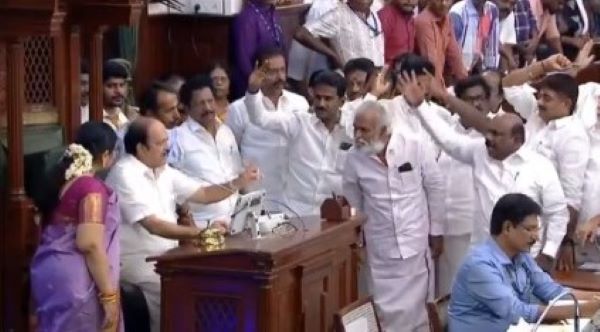
The DMK members, however, continued their protest, moved towards the Speaker’s podium and gathered in the Well of the House. After repeated warnings failed to restore order, the Speaker directed marshals to remove them.
The confrontation brought the spotlight not only on the allegations exchanged across the floor but also on a larger democratic principle: the Assembly belongs to the people, and its time must ultimately be used in the public interest.
DMK seeks expunction of Vijay’s controversial references
Trouble began soon after proceedings commenced when DMK Whip E.V. Velu objected to remarks made by Vijay during Monday’s proceedings.
Velu argued that the Chief Minister’s references to ED communications and the Sarkaria Commission report violated Assembly rules and should therefore be expunged from the record.
Vijay had cited an ED communication while alleging that contractors handling works for the Municipal Administration and Water Supply Department were made to pay between 7.5% and 10% of contract values as “party funds”.
He had also referred to findings of the Sarkaria Commission relating to the Veeranam drinking-water project during an earlier DMK government.
Velu disputed the manner in which the material was presented, arguing that the Sarkaria Commission had not established criminal offences. He also objected to references concerning former DMK leaders and allegations linking government contracts with party funds.
The Opposition’s position was that politically contentious allegations should not be allowed to acquire the status of established fact merely because they are made on the floor of the House.
Government stands by Chief Minister’s statement
The government rejected the DMK’s objections.
Law Minister R. Nirmal Kumar defended Vijay, saying that the Chief Minister had based his statement on official ED material and the Sarkaria Commission report.
The government maintained that the information referred to by Vijay was already available in the public domain and therefore did not warrant expunction merely because it was politically uncomfortable for the Opposition.
The distinction is important. Political allegations made in the Assembly remain allegations unless established through the appropriate legal or investigative process. At the same time, the right of an elected government to place its political case before the legislature is an essential component of democratic debate.
The challenge is to ensure that such debate remains within the boundaries of parliamentary procedure.
Speaker rejects demand, offers Opposition an opportunity to respond
Speaker J.C.D. Prabhakar rejected the DMK’s demand for expunction.
He said there was nothing improper in the Chief Minister referring to publicly available documents or matters that had previously been discussed in the Assembly. He also noted that Vijay had completed his speech on Monday despite repeated objections from the Opposition benches.
The Speaker subsequently indicated that either Velu or K.N. Nehru could be allowed to speak on the issue if the members returned to their seats and order was restored.
That effort, however, failed to pacify the protesting legislators.
DMK members continued shouting slogans and moved towards the Speaker’s podium, with several gathering in the Well and demanding that Vijay’s remarks be removed from the record.
From protest to eviction as House rules take centre stage
Leader of the House K.A. Sengottaiyan then sought action against the protesting members under Assembly rules.
The Speaker gave the DMK legislators time to return to their seats and warned them against continuing the disruption. He also objected to the display of posters brought into the chamber without permission.
When the protest continued, Prabhakar directed Assembly marshals to remove the DMK legislators.
The members continued raising slogans as they were escorted out, taking the confrontation over Vijay’s allegations into a second consecutive day.
The incident once again demonstrated the difficult balance between an Opposition’s legitimate right to protest and the Chair’s responsibility to ensure that legislative proceedings continue without obstruction.
What the rules mean—and what they do not mean
The episode also raises an important question about Assembly procedure.
Tamil Nadu Assembly rules provide the Speaker with powers to regulate proceedings, including mechanisms for dealing with objectionable remarks and disorderly conduct. The rules provide for the expunction of defamatory, indecent, unparliamentary, undignified or incriminatory expressions and also contain provisions for dealing with members who persistently and wilfully obstruct the business of the House.
That does not mean, however, that every politically controversial statement can automatically be removed from the record simply because the Opposition objects to it.
Equally, disagreement with a ruling of the Chair does not provide an unlimited licence for members to occupy the Well, display unauthorised material or repeatedly prevent proceedings from continuing.
The strength of parliamentary democracy lies precisely in the availability of institutional remedies—raising points of order, seeking a ruling, moving appropriate motions, demanding a response and placing a counter-argument on record.
Should taxpayers pay for legislative disruption?
This is where the debate must move beyond the immediate clash between political parties.
The Tamil Nadu Assembly is sustained by public money. Its members are elected to scrutinise legislation, examine expenditure, question the government, debate policies and represent the concerns of millions of citizens.
Every minute lost to prolonged disruption is therefore not merely a political statistic. It represents legislative time that taxpayers fund but citizens do not get back.
There is no simple automatic rule under which every loss of House productivity translates into a proportionate deduction from an MLA’s salary. Attendance-linked allowances and disciplinary consequences following formal suspension are separate matters governed by the applicable law and Assembly rules.
That distinction is important.
But it does raise a legitimate public-policy question: should persistent and deliberate disruption have stronger, transparent institutional consequences, consistent with constitutional safeguards and legislative privilege?
Any such mechanism would require careful legal and constitutional examination. It cannot simply be imposed as an arbitrary “productivity penalty”.
Political maturity is required from all stakeholders
The deeper lesson from the latest confrontation is that political maturity cannot be demanded from only one side.
The government must ensure that serious allegations placed before the Assembly are presented responsibly, with documentary support where claimed, and without converting political accusations into declarations of guilt.
The Opposition has an equally important responsibility. It must challenge allegations vigorously, defend its record and demand answers—but it must use the procedures of the House rather than allow protest to repeatedly overwhelm proceedings.
The Speaker, meanwhile, has the most delicate role of all: to enforce the rules firmly while maintaining the confidence that the Chair is acting impartially and providing adequate opportunity to both sides.
Tamil Nadu needs an Assembly where disagreement produces better scrutiny, not fewer working hours; where allegations trigger evidence-based debate, not endless disruption; and where political rivalry does not eclipse public responsibility.
The House’s time is not the property of the Treasury benches or the Opposition. It belongs to the people.
And the money that keeps the legislature functioning comes from the taxpayers.
Political parties will inevitably fight elections, defend their leaders and attack their opponents. That is part of democracy. But when the Assembly is in session, all stakeholders have a larger responsibility to rise above party politics and protect the productivity and dignity of the House.
The real measure of parliamentary democracy is not how loudly politicians can fight, but how effectively they can use the House to question, debate, legislate and deliver for the people.
Tamil Nadu’s taxpayers deserve nothing less.