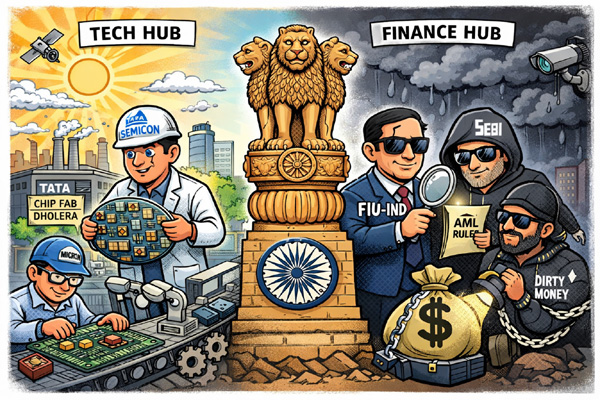
- Tata-led ₹91,000-crore Chip Fab at Dholera marks India’s semiconductor turning point
- SEZ reforms unlock mega investments, boost ease of doing business in high-tech manufacturing
- Micron, Aequs & others power multi-state electronics ecosystem with strong job creation
- FIU-IND & SEBI forge intelligence alliance to combat money laundering, strengthen AML framework
- Twin push positions India as Secure, Self-Reliant Global Hub for Tech Manufacturing & Finance
NE BUSINESS BUREAU
NEW DELHI / GANDHINAGAR, APR 17
In a decisive dual push to cement its position as a global technology and financial powerhouse, the Government of India has simultaneously accelerated its semiconductor manufacturing ambitions and strengthened its financial surveillance architecture—signalling a new phase of industrial and regulatory transformation.
At the heart of the manufacturing thrust is the notification of India’s first semiconductor fabrication plant by Tata Semiconductor Manufacturing Private Limited at Dholera, Gujarat. Spread over 66.166 hectares, the Special Economic Zone (SEZ) is expected to attract an investment of ₹91,000 crore and generate employment for around 21,000 people, marking a historic leap in India’s quest for chip self-reliance.
The Dholera fab—an AI-enabled semiconductor facility—anchors a broader policy push that includes targeted amendments to the SEZ Rules, 2006. These reforms, notified in June 2025, have significantly lowered entry barriers for high-tech industries by reducing the minimum land requirement from 50 hectares to 10 hectares, easing encumbrance norms, allowing domestic tariff area (DTA) sales on duty payment, and factoring in free-of-cost supplies in Net Foreign Exchange calculations.
These policy recalibrations have already catalysed a wave of high-value investments. Notably, Micron Semiconductor Technology India Pvt Ltd is setting up a ₹13,000-crore semiconductor assembly and testing unit in Sanand, Gujarat, while Aequs Group is establishing an electronics component manufacturing SEZ in Dharwad, Karnataka. Other key players such as CG Semi and Kaynes Semicon are also expanding India’s outsourced semiconductor assembly and testing (OSAT) capabilities.
Collectively, these projects are expected to generate tens of thousands of direct and indirect jobs while strengthening domestic value chains and reducing reliance on imports—laying the groundwork for an integrated, future-ready semiconductor ecosystem.
Parallel to this industrial momentum, India has sharpened its financial vigilance framework. In a significant regulatory development, the Financial Intelligence Unit-India and the Securities and Exchange Board of India have signed a comprehensive Memorandum of Understanding (MoU) to enhance coordination in tackling money laundering and financial crimes.
The MoU, signed by Amit Mohan Govil, Director, FIU-IND, and Sandip Pradhan, Whole Time Member, SEBI, establishes a robust mechanism for intelligence sharing, risk assessment, and regulatory coordination. It lays down procedures for reporting entities under the Prevention of Money Laundering (PML) framework and facilitates information exchange with global counterparts under the Egmont Principles.
The collaboration will also focus on identifying red-flag indicators for suspicious transactions, conducting joint outreach and training programmes, and strengthening Anti-Money Laundering and Combating Financing of Terrorism (AML/CFT) capabilities across regulated entities. Quarterly engagements between the two bodies will further institutionalise information exchange and policy alignment.
Crucially, the partnership will enhance supervision and compliance monitoring under the PMLA and SEBI regulations, ensuring that India’s financial markets remain resilient, transparent, and globally compliant.
Together, the semiconductor push and financial oversight reforms underscore a strategic convergence—where cutting-edge manufacturing growth is matched by robust regulatory safeguards. This twin-track approach is positioning India not just as an emerging hub for electronics and chip production, but also as a secure and trusted financial ecosystem in an increasingly complex global landscape.