NE BUSINESS BUREAU
NEW DELHI, JULY 6
Declaring that India’s cooperative movement is entering its most transformative phase since Independence, Amit Shah, Union Home and Cooperation Minister, on Monday unveiled an ambitious roadmap to make cooperatives a cornerstone of Viksit Bharat 2047, asserting that the sector would evolve into one of the world’s largest people-driven economic ecosystems.
किसानों को समृद्ध, महिलाओं को सशक्त, युवाओं को स्वावलंबी और देश की अर्थव्यवस्था को मजबूत बनाने के लक्ष्य के साथ 5 वर्ष पूर्व मोदी जी के दूरदर्शी नेतृत्व में सहकारिता मंत्रालय की स्थापना की गई।#SahkarSeSamriddhiKe5Saal में कृषि, डेयरी, बैंकिंग, लॉजिस्टिक्स और मोबिलिटी जैसे… pic.twitter.com/o18xaWpBm9
— Amit Shah (@AmitShah) July 6, 2026
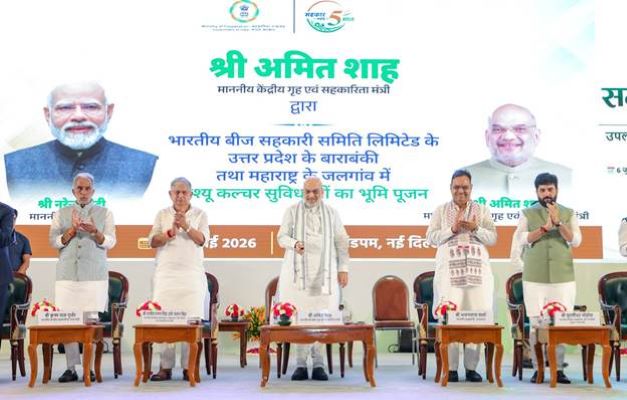
Addressing the 5th Foundation Day celebrations of the Ministry of Cooperation in New Delhi, Shah said the Ministry’s five-year journey has infused fresh momentum into the lives of nearly 32 crore cooperative members and more than 8.5 lakh cooperative institutions, while laying the foundation for a modern, transparent, technology-driven and globally competitive cooperative framework.
- Ministry of Cooperation marks five transformative years with sweeping reforms aimed at empowering 32 crore members and over 8.5 lakh cooperative institutions
- From digital governance and e-PACS to Bharat Beej, Bharat Taxi and Tribhuvan Cooperative University, a new ecosystem takes shape for rural prosperity
- Government targets world-class cooperative institutions in seeds, exports, dairy, banking, logistics, mobility and organic farming over the next decade
- ‘Leadership, technology and transparency’ emerge as the three pillars driving India’s cooperative renaissance under Viksit Bharat 2047
- Amit Shah says the cooperative movement will become the strongest foundation of a prosperous India by the centenary of Independence
- New projects, AI-enabled banking platforms, seed systems and circular economy initiatives launched to accelerate inclusive rural growth
सहकारिता मंत्रालय गत 5 वर्षों से ‘सहकार से समृद्धि’ के मंत्र पर चल करोड़ों लोगों के जीवन में बदलाव ला रहा है। नई दिल्ली में सहकारिता मंत्रालय की स्थापना के 5 वर्ष पूर्ण होने पर आयोजित कार्यक्रम से लाइव… https://t.co/I4FaszmxrQ
— Amit Shah (@AmitShah) July 6, 2026
“When the nation celebrates the centenary of its Independence in 2047, the cooperative movement will serve as the strong foundation of a Prosperous India.”
Tracing the Ministry’s evolution since its establishment in July 2021, Shah said the government had transformed a sector that had long remained fragmented into a unified national movement spanning agriculture, dairy, banking, logistics, exports, mobility, organic farming, digital services and green energy.
He said the Ministry had identified structural gaps, introduced comprehensive reforms and created a nationwide digital database covering 8.58 lakh cooperative societies across 30 sectors and over 32 crore members, enabling states to identify areas lacking Primary Agricultural Credit Societies (PACS), dairy cooperatives and other institutions.
Calling the past five years a defining period, Shah remarked: “In its five-year journey, the Ministry has identified the key challenges facing the cooperative sector, prepared a comprehensive roadmap for its development and resolution, and transformed the cooperative ecosystem into one that is modern, transparent, technology-driven, and competitive.”
One of the flagship announcements centred on the rapid expansion of The Bharat Beej Sahakari Samiti Limited (BBSSL), which Shah said is poised to become India’s largest seed production company within the next three years.
“The Bharat Beej Sahakari Samiti Limited (BBSSL) will emerge as the country’s largest seed production company within the next three years. New units in every State will ensure that farmers have access to high-quality and improved seeds.”
He added that India is working to connect farmers directly with international markets through cooperative institutions while positioning itself as a global leader in seed production.
Highlighting the Ministry’s institutional expansion, Shah said nine national-level cooperative societies now integrate sectors ranging from agriculture and dairy to logistics, banking and mobility.
“By establishing nine national-level cooperative societies, the Government has woven the cooperative movement into a unified framework across nine sectors, extending its reach to the village level. Over the next decade, these institutions are poised to become the world’s largest cooperatives.”
Emphasising professional management, Shah said the newly established Tribhuvan Cooperative University would prepare skilled professionals across banking, dairy, agriculture, fertilisers, marketing and allied sectors, ensuring transparency and efficiency in cooperative governance.
He also highlighted the digital transformation of grassroots institutions, noting that 50,000 PACS have already become e-PACS, while 55,000 PACS are delivering over 300 citizen-centric services through Common Service Centres.
The cooperative banking ecosystem has also witnessed significant improvement, with the business volume of District Cooperative Banks crossing ₹25 lakh crore, while gross NPAs have declined sharply from 12.8 per cent to 6.2 per cent, reflecting stronger financial health and public confidence.
Shah said organic farming, circular economy initiatives, cattle waste management, renewable energy generation and indigenous fertiliser production are now being integrated into the cooperative model to accelerate sustainable rural development.
“Organic farming, the circular economy, cattle waste management, organic fertilisers, and energy generation are being integrated with the cooperative model to accelerate the growth of the rural economy.”
He urged farmers to embrace indigenous organic alternatives, saying higher productivity and healthier soils could coexist through scientific cooperative practices.
The event also witnessed the launch and inauguration of several flagship initiatives, including new foodgrain storage infrastructure, BBSSL tissue culture facilities, NCD 3.0, geo-tagging applications, AI-powered banking platforms for Urban Cooperative Banks, dairy productivity initiatives, the Gomay Cooperative Society Multi-State Limited, and a milestone marking the digital transformation of 50,000 PACS into e-PACS.
An MoU between BBSSL and the Indian Council of Agricultural Research (ICAR) was also signed to strengthen India’s seed ecosystem, while model by-laws for dairy cooperative societies and a publication documenting the Ministry’s achievements over the past five years were released.
Positioning cooperation as a central pillar of India’s development journey, Shah said the government’s vision extends beyond strengthening institutions to ensuring that prosperity reaches those who create it.
“Our effort will be to ensure that the entire profit of this sector reaches, with dignity, the person who has the rightful claim over it — the farmer and the animal husbandry worker.”
With technology, institutional reforms and professional governance driving the next phase of expansion, the Ministry of Cooperation has set an ambitious course to transform India’s cooperative movement into a globally recognised model of inclusive, farmer-centric and sustainable economic development.