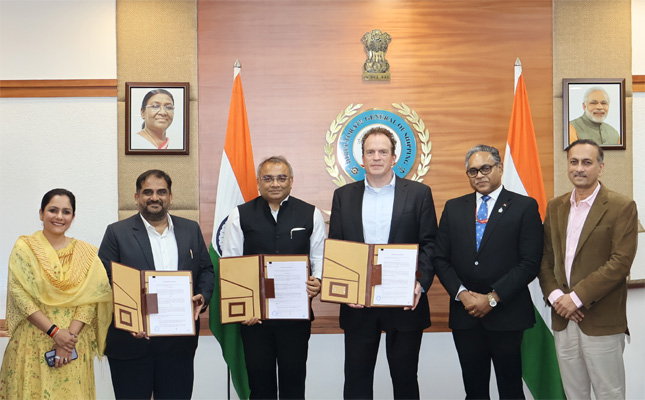
- Historic First Ends India’s Long Wait for Structured Maritime Emergency Infrastructure
- Twin Coastal Shields at Dighi & Gopalpur to Safeguard Global Shipping Arteries
- Global Muscle Onboard: MoU with SMIT Salvage, Royal Boskalis Westminster N.V. & MERC
- From Rescue to Resilience: Firefighting, Salvage, Pollution Control Under One Command
- Aligning with Global Norms, India Elevates Its Standing in International Shipping Corridors
NE BUSINESS BUREAU
AHMEDABAD, MAR 27
In a landmark feat that redraws India’s maritime safety map, Adani Ports and Special Economic Zone Ltd has operationalised the nation’s first-ever Port of Refuge (PoR)—plugging a critical infrastructure gap and establishing a robust, structured mechanism to respond to vessels in distress.
A Port of Refuge, as defined by the International Maritime Organization, is a designated safe haven where ships can stabilise, protect lives, and prevent environmental disasters. While such systems are standard across major maritime economies, India—despite its 11,000-km coastline and strategic position on global trade routes—is only now entering this league.
Strategic Twin Anchors Across Coasts
APSEZ has designated Dighi Port (west coast) and Gopalpur Port (east coast) as PoR hubs—creating a dual-shield safety grid across the Arabian Sea, Persian Gulf routes, Bay of Bengal, and the Malacca Strait, one of the world’s busiest maritime corridors.
These facilities will deliver end-to-end emergency capabilities including salvage and wreck removal, firefighting, pollution containment, and coordinated crisis response, backed by specialised equipment and trained teams.
Global Expertise, Local Execution
The initiative gains international depth through a tripartite MoU with SMIT Salvage—the salvage arm of Royal Boskalis Westminster N.V.—and the Maritime Emergency Response Centre (MERC), ensuring world-class, coordinated action. The framework also aligns with the International Group of Protection and Indemnity (P&I) Clubs, integrating India into global maritime risk and liability systems.
Leadership Voices on a Defining Leap
Ashwani Gupta, Whole-time Director and CEO, APSEZ, said, “This milestone marks a significant step in strengthening India’s maritime safety ecosystem. Ports connect economies—but a Port of Refuge protects lives. By establishing dedicated PoR infrastructure, we are elevating India’s maritime preparedness and setting a new benchmark for world-class coastal safety. At APSEZ, we believe world-class infrastructure must be matched by world-class responsibility.”
Shyam Jagannathan, IAS, Director General of Shipping, said, “The initiative marks an important step in strengthening India’s maritime preparedness and emergency response capacity. The adoption of a standardized Port of Refuge framework will enable more coordinated and timely action during maritime incidents, ensuring effective protection of life, cargo, and the coastal environment. I commend all stakeholders for their collaborative efforts in operationalising this important capability.”
Richard Janssen, Managing Director, SMIT Salvage (Boskalis), said, “We are strengthening maritime safety and care for the marine environment where it matters most, and in doing so jointly protect India’s coastline and society. Providing a Port of Refuge to a casualty is critical in a salvage operation to ensure that the vessel and her cargo are dealt with swiftly and professionally and that the affected cargo and fire- fighting water is treated and disposed of in accordance with the applicable legislation. SMIT Salvage is pleased to bring global best-in-class salvage capability and experience to ensure faster, safer, and coordinated emergency response along India’s key shipping routes.”
A new maritime order for India
By institutionalising the Port of Refuge framework, APSEZ is not just enhancing emergency readiness—it is elevating India’s credibility as a responsible maritime power, strengthening environmental safeguards, and reinforcing its position along critical global shipping corridors.