- ₹805-crore IPO opens September 9 as Manipal Group company takes its payment, identity and IoT franchise to Dalal Street
- ₹320 crore fresh capital to fund equipment expansion; promoter Manipal Technologies to sell ₹485 crore stake
- 75% QIB, 15% NII and 10% retail allocation; 44-share retail lot costs ₹14,916
- FY26 revenue rises 6.2% to ₹1,356.59 crore; EBITDA climbs to ₹455.83 crore
- Credit-card and debit-card market shares of 36.4% and 30.9% underline the company’s payment infrastructure heft
R MANICKAVASAGAM
AHMEDABAD, SEPT 7
Every swipe, tap, identity card and secure document represents more than a transaction—it represents trust. Manipal Payment and Identity Solutions Ltd is now taking that trust to Dalal Street with an ₹805-crore IPO, positioning itself at the intersection of payments, identity, secure printing, smart tagging and IoT.
The Manipal Group company has fixed the price band at ₹322–339 per share, valuing it at approximately ₹7,858 crore at the upper end. The issue opens September 9 and closes September 11. Anchor bidding is scheduled for September 8, with listing on the BSE and NSE on September 17.
With estimated 36.4% share of India’s credit-card issuance market and 30.9% of the debit-card issuance market in FY26, Manipal Payment is pitching itself as a critical manufacturing and technology backbone of India’s expanding digital-payment and identity ecosystem.
₹320 crore fresh capital; ₹485 crore OFS
The IPO comprises a ₹320-crore fresh issue and an Offer For Sale of 1.43 crore shares worth about ₹485 crore by promoter Manipal Technologies.
Around ₹238.4 crore of the fresh proceeds will be deployed towards purchasing and installing new and second-hand equipment at facilities in Manipal, Chennai, Navi Mumbai and the Chhattisgarh RTO, with the balance earmarked for general corporate purposes.
Strong operating engine, virtually debt-free balance sheet
Financially, the company enters the IPO with considerable operating muscle. Consolidated revenue from operations rose to ₹1,326.75 crore in FY26 from ₹1,277.11 crore in FY25, while total revenue reached ₹1,356.59 crore.
EBITDA climbed sharply to ₹455.83 crore from ₹408.77 crore, taking the operating margin to roughly 34.4%.
PAT, however, moderated to ₹253.46 crore from ₹282.21 crore, largely reflecting the exceptionally high previous-year base that included substantial exceptional gains.
A striking balance-sheet improvement is the near elimination of borrowings—from ₹472.87 crore in FY25 to just ₹0.42 crore in FY26—while net worth rose to ₹1,107.34 crore.
Beyond cards: technology becomes the next battleground
Cards remain the company’s principal revenue engine, accounting for 57.25% of FY26 revenue from operations, but its portfolio extends to prepaid cards, cheque solutions, NFC and QR-enabled products, payment wearables, driving licences, registration certificates, national identity cards, secure printing and IoT-enabled smart tagging.
The company produced 13.54 million credit cards and 72.66 million debit cards in FY26 and operates 10 manufacturing and processing facilities across India.
The next competitive frontier, however, is technology.
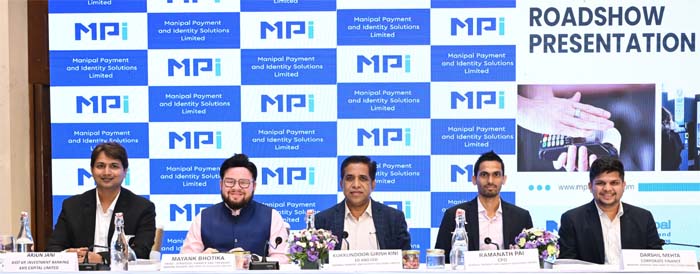
Asked how the company is responding to rapid disruption in payments and identity solutions, Manipal Payment Executive Director and CEO Kukkundoor Girish Kini said the company has been investing heavily in the research and development of AI, cybersecurity, data protection and fraud-prevention systems, along with biometrics, cloud and other emerging technologies.
This technology push is aimed at ensuring that the company’s established manufacturing capabilities remain relevant as payment and identity ecosystems become increasingly digital, connected and security-sensitive.
Cybersecurity under regulatory guardrails
Given the sensitive nature of payment and identity data, cybersecurity is an equally critical investor consideration.
Kini said: “Owing to our strict regulatory compliances mandated by the RBI and other regulators, our company has not faced any significant security breaches or regulatory concerns so far.”
He added that the company has been investing heavily in cybersecurity, data protection and fraud-prevention systems, strengthening the security architecture around its operations.
The company also holds PCI DSS Level 1 Version 4.0.1 certification, alongside long-standing Mastercard and RuPay certifications.
A sticky 300-plus customer franchise
Manipal Payment serves more than 300 customers, including private- and public-sector banks, small finance banks and co-operative banks, across domestic and international markets.
Customer stickiness is a key strength: 211 customers, or 61.34%, had been serviced for more than five years in FY26.
The company employs more than 1,800 specialists and operates across payment cards, identity solutions, secure documents and IoT-enabled applications.
Concentration risks remain
Investors, however, will need to weigh the strengths against concentration risks. Cards contributed 57.25% of revenue, while the top 10 customers accounted for 58.67% of revenue and the top 10 suppliers for 56.05% of purchases. Import dependence stood at about 49.56% of total purchases.
Contingent liabilities of approximately ₹142.21 crore as of March 31, 2026, also merit scrutiny.
At the upper price band, the ₹7,858-crore valuation places a premium on Manipal Payment’s market leadership, strong EBITDA and virtually debt-free balance sheet.
The larger investment question is whether the company can successfully make the transition from a dominant payment-card manufacturer to a technology-enabled infrastructure partner spanning payments, identity, cybersecurity and IoT.
That transition could ultimately determine whether Manipal Payment’s new identity on Dalal Street becomes as powerful as its established identity in India’s trust economy.