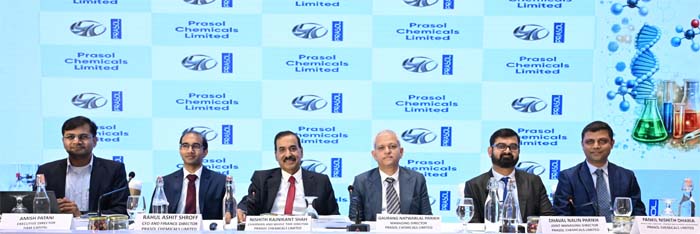
- ₹643–676 price band puts the 1992-born specialty-chemical maker on the market radar, with ₹80 crore fresh capital and ₹420 crore OFS
- FY26 revenue climbs 22% to ₹1,232.59 crore, EBITDA surges 59% to ₹139.32 crore and PAT nearly doubles to ₹83.12 crore
- Anchor-investor bidding takes place today, September 7, ahead of public subscription opening on September 8; final anchor allocation awaited
- Chairman says margins have remained resilient despite raw-material and global-demand swings; company maintains “highest standard” of safety and environmental compliance
- With 150-plus products, 1,600-plus customers across 69 countries and acetone and phosphorus chemistries driving the business, investors face a growth-versus-valuation test
NE BUSINESS BUREAU
AHMEDABAD, SEPT 7
Can a 33-year-old speciality-chemical maker turn strong earnings momentum, a diversified product basket and global customer base into a compelling Dalal Street story? Prasol Chemicals is about to put that proposition to the public-market test.
Prasol Chemicals Ltd will open its ₹500-crore initial public offering on September 8, with a price band of ₹643–676 per share. The three-day issue closes on September 10, while anchor-investor bidding is taking place today, September 7, a day ahead of the public issue.
The IPO comprises a fresh issue of ₹80 crore and an Offer for Sale of ₹420 crore. At the upper band, the issue implies a post-issue equity valuation of about ₹4,001 crore. The fresh proceeds will primarily strengthen the balance sheet, with ₹60 crore earmarked for repayment/prepayment of borrowings and the remainder for general corporate purposes.
Earnings provide the first big attraction
Prasol’s financial numbers offer a strong growth narrative.
Revenue from operations rose from ₹876.57 crore in FY24 to ₹1,012.49 crore in FY25 and ₹1,232.59 crore in FY26.
EBITDA jumped from ₹60.53 crore to ₹87.77 crore and then ₹139.32 crore, representing a nearly 59% increase in FY26. EBITDA margin consequently expanded to about 11.3%.
PAT climbed from ₹18.13 crore in FY24 to ₹43.57 crore in FY25 and ₹83.12 crore in FY26, almost doubling year-on-year. FY26 diluted EPS stood at ₹14.33.
The company operates two manufacturing facilities in Maharashtra and has a portfolio of more than 150 speciality chemicals, serving performance chemicals, paints, inks, construction and adhesives, pharmaceuticals, agrochemicals, and home and personal care.
Acetone and phosphorus drive the chemistry
The business is built around acetone-based and phosphorus-based speciality chemicals, along with customised products including surfactants, performance additives, ethers, esters, polymers and acids.
In FY26, acetone-based speciality chemicals contributed about 43% of revenue, while phosphorus-based products accounted for around 38%.
Prasol serves more than 1,600 customers across 69 countries, giving it an export-oriented growth platform. Its customers include Alembic Pharmaceuticals, Clean Science and Technology, Coromandel International and Lubrizol India.
Chairman: Margins resilient to volatility
Speciality chemicals are inherently exposed to raw-material prices, crude-linked feedstocks, energy costs, foreign exchange and swings in global demand. Asked how resilient Prasol’s margins are to these pressures, Prasol Chairman and Whole-Time Director Nishith Rajnikant Shah said the company has not faced material volatility affecting its margins.
He said the company’s “margins have always been resilient to all these factors.”
The management’s response is particularly relevant given the sharp expansion in profitability over FY24–FY26, with EBITDA margin rising from about 6.9% to 11.3%.
Safety and environment under investor lens
Environmental, health and safety compliance is another critical issue for chemical manufacturers.
Asked about investments in effluent treatment, waste management, emissions control and process safety, Shah said the company has been maintaining the “highest standard of safety and environment regulations.”
For investors, environmental and regulatory compliance remains an important diligence point for any chemical manufacturer, particularly one operating across multiple specialised chemistries. Prasol’s facilities and regulatory registrations therefore form an important part of the risk assessment alongside its growth numbers.
IPO: Growth capital or shareholder exit?
The structure of the issue itself provides an important clue. Of the ₹500 crore being raised, ₹420 crore—or 84%—is an OFS, meaning the bulk of the proceeds will go to selling shareholders rather than the company.
Only ₹80 crore is fresh capital, with ₹60 crore earmarked for debt reduction. Prasol’s borrowings stood at about ₹110.06 crore as of March 31, 2026.
The issue reserves up to 50% for QIBs, at least 15% for NIIs and at least 35% for retail investors. The minimum retail application is 22 shares, requiring ₹14,872 at the upper band.
Anchor book: institutional verdict awaited
The anchor-investor bidding window opens today, September 7, ahead of the public issue. However, the final anchor allocation—including the institutional names, number of shares and amount raised—was not yet available in the latest reliably verifiable sources at the time of writing. (MarketPing)
That institutional response could provide an early indication of appetite for Prasol’s growth story before retail and other investors enter the book on September 8.
The chemistry investors must get right
Prasol offers several positives: rapidly improving earnings, a diversified speciality-chemical portfolio, international customers, export presence and sharply higher profitability.
But the investment case also carries watchpoints—customer and product concentration, raw-material dependence, speciality-chemical cyclicality, environmental compliance and the predominantly OFS-led issue structure.
At ₹676, the stock is priced at roughly 47 times FY26 diluted EPS of ₹14.33, making continued earnings momentum central to the valuation case.
The final test, therefore, is not simply whether Prasol can make more speciality chemicals. It is whether it can sustain its margin resilience, convert its global customer base into durable growth and justify the premium investors are being asked to pay.
The IPO is managed by DAM Capital Advisors, with KFin Technologies as registrar. The shares are proposed to be listed on the BSE and NSE, with listing scheduled for September 16.