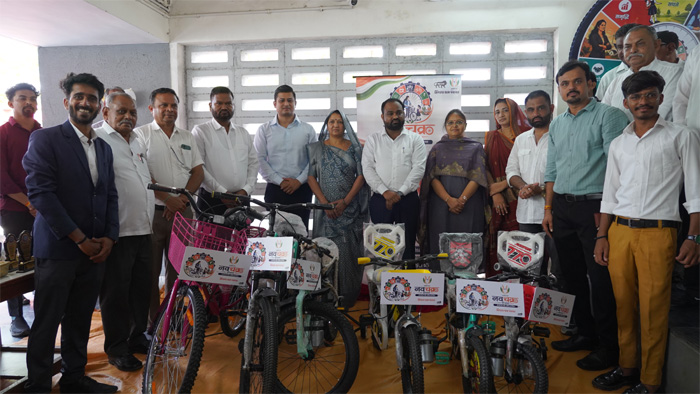
- Village women assemble every bicycle, transforming a mobility initiative into a powerful model of grassroots entrepreneurship and self-reliance
- 1,700 cycles to help government school students pursue education, empower daughters and bridge mobility gaps in rural Gujarat
- Inspired by Prime Minister Narendra Modi’s advocacy of pedal power and aligned with Ahmedabad’s cyclist- and pedestrian-centric mobility vision
- Campaign promotes traffic-rule awareness among students while reinforcing the rights of cyclists and safer roads for all
R MANICKAVASAGAM
AHMEDABAD, JUNE 23
In a remarkable example of grassroots innovation, women-led manufacturing and social transformation, 1,700 bicycles assembled entirely by women of Singarva village are set to become powerful ‘Wheels of Change’, helping students access education, creating livelihoods for rural women and promoting environmentally sustainable mobility.
Launched amid much enthusiasm under the ‘Navchakra Yojana’, the initiative seeks to convert a simple bicycle into a vehicle of opportunity, dignity and empowerment. The programme was organised by the Singarva Gram Panchayat under the leadership of Sarpanch Ankitsinh Chauhan and Sitaben Chauhan, with the inspiring mottos “Speed to Dreams, Direction to Future” and “One Bicycle, Millions of Dreams.”
At a time when Prime Minister Narendra Modi has consistently advocated cycling and non-motorised transport as energy-saving, environment-friendly and health-promoting solutions, the Singarva initiative offers a compelling grassroots model that blends education, women empowerment, local manufacturing and green mobility.
The programme also resonates with Ahmedabad’s growing emphasis on creating cyclist-friendly and pedestrian-centric roads, encouraging safer and more sustainable modes of transportation in India’s first UNESCO World Heritage City.
Addressing the gathering, Sarpanch Ankitsinh Chauhan highlighted the broader vision of the scheme.
“The main objective of the scheme is to empower village women with employment opportunities and encourage government school students by distributing bicycles to them.”
What makes the initiative truly distinctive is that all 1,700 bicycles have been assembled by women from Singarva village, transforming the programme from a conventional bicycle-distribution drive into a powerful symbol of economic self-reliance and women-led development.
By participating in bicycle assembly, related technical work and local production activities, village women have acquired valuable skills, generated income opportunities and strengthened their role in the community’s economic progress.
The initiative demonstrates how rural women can become active contributors to development while embodying the spirit of ‘Make in India’ and ‘Atmanirbhar Bharat’.
The scheme’s educational dimension is equally significant. By making transportation easier and more affordable, the bicycles will help government school students travel comfortably to schools, reducing mobility barriers that often affect attendance and academic continuity, particularly among girls.
The vision behind Navchakra Yojana is to ensure that every child has an opportunity to pursue quality education and every daughter has the confidence to dream bigger. Organisers believe the initiative will strengthen the ideals of “Education for Every Child” and “Respect for Every Daughter.”
Village leaders described Navchakra Yojana as a broader social movement aimed at delivering “Opportunity for Every Youth” and “Progress for Every Household.”
Beyond education and empowerment, the initiative is expected to generate additional employment opportunities through bicycle manufacturing, maintenance, servicing and skill-development activities for local youth.
The project also places strong emphasis on green mobility and road safety awareness. Students benefiting from the scheme will be encouraged to adopt responsible cycling habits and learn traffic rules, helping create a generation of environmentally conscious and safety-aware citizens.
The initiative gains added significance in light of the spirit of various observations made by the Supreme Court, which has repeatedly stressed the importance of safer roads, improved infrastructure and the protection of vulnerable road users, including cyclists and pedestrians, whose rights to safe mobility deserve equal recognition.
As India searches for sustainable transportation alternatives and inclusive development models, Navchakra Yojana offers a compelling example of how a simple bicycle can transform lives by improving access to education, promoting gender equality, conserving energy and creating economic opportunities.
The organisers concluded the event with a message that perfectly captures the essence of the movement: “Today’s bicycle will pave the way for a successful life tomorrow.”
For the women who assembled them and the students who will ride them, these 1,700 bicycles are far more than machines. They are symbols of aspiration, confidence, opportunity and a brighter future powered by education, empowerment and sustainable mobility.