R ARIVANANTHAM
CHENNAI, MAR 29
As M. K. Stalin prepares to formally launch the DMK’s Assembly election campaign from Tiruvarur on March 31, the move is being read not merely as a political kickoff but as a carefully staged assertion of legacy, leadership and long-term strategy.
- Tiruvarur Launch Signals Legacy + Strategy Fusion
- “Alliance of Principles” Anchors DMK’s Electoral Narrative
- Brand Stalin vs Star Power, Caste Equations & Fragmented Opposition
- Karunanidhi’s Legacy Meets Stalin’s Governance Model
- Soft Power Politics vs Aggressive Rivals: A Calculated Contrast
- Welfare, Federalism & Social Justice Form DMK’s Core Pitch
The symbolic choice of Tiruvarur—birthplace of M. Karunanidhi—anchors the campaign in Dravidian history even as Stalin attempts to script a forward-looking electoral narrative. With candidates announced for 164 constituencies and 70 seats allotted to allies, the DMK-led alliance has shifted decisively into campaign mode ahead of the April 23 polls.
The campaign core: Legacy + Delivery + Discipline
At the heart of Stalin’s strategy lies a three-layered approach—invoking legacy, showcasing governance, and maintaining alliance discipline.
Calling the coalition “not merely an alliance of arithmetic but an alliance of principles,” Stalin underscored the ideological glue holding together the Secular Progressive Alliance. The line, widely amplified across social media, reflects a conscious attempt to elevate the contest beyond seat-sharing math.
A senior DMK functionary summed up the pitch: “This election is about continuity of governance and protection of Tamil Nadu’s social justice model.”
Tackling the challengers: A multi-front strategy
The 2026 battle is far from straightforward. Stalin faces a diverse opposition spectrum:
- Vijay brings celebrity appeal and youth traction
- Edappadi K. Palaniswami banks on organisational strength
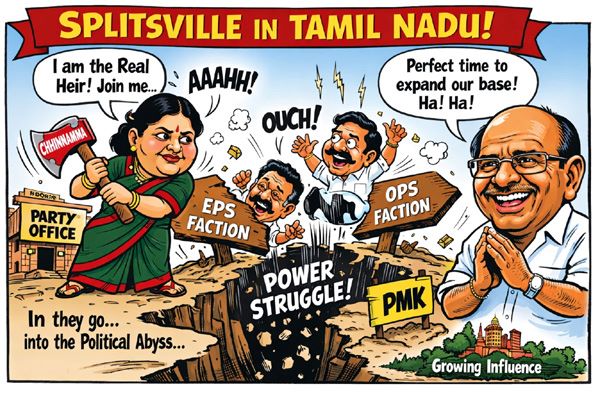
- V. K. Sasikala (Chinnamma) seeks emotional recall within AIADMK cadres
- Seeman mobilises Tamil nationalist sentiment
- K. Annamalai (Krishnamurthy) sharpens ideological attacks
How Stalin counters them
Against Vijay
DMK’s counter is governance credibility over charisma. Party insiders say the messaging will subtly question “administrative experience versus cinematic appeal.”
Against EPS & Sasikala
The DMK aims to exploit factional divisions. A strategist noted: “A divided opposition is our biggest advantage—we will keep the focus there.”
Against Seeman
Stalin’s inclusive Dravidian model is projected as broader and more sustainable than single-issue nationalism.
Against BJP & Annamalai
Federal autonomy and anti-centralisation rhetoric remain key. Stalin’s consistent opposition to Hindi imposition and NEP is expected to dominate speeches.
Brand Stalin: The quiet architect
Unlike the fiery oratorical dominance of Karunanidhi, Stalin’s leadership is being framed as calm, consultative and delivery-driven.
DMK spokesperson S.K.P. Karuna observed: “He is an inclusive leader. No one has heard him speak harshly or show anger.”
Political observers point to defining moments that built this “quiet brand”—from personally visiting Covid wards to swiftly extending welfare schemes based on public feedback.
A viral social media moment—his silent hand gesture signalling the end of alliance talks—further reinforced an image of understated authority.
Karunanidhi Vs Stalin: Legacy reimagined
Where Karunanidhi thrived on rhetoric, Stalin has leaned into governance.
Karunanidhi’s strengths
- Commanding oratory
- Ideological articulation
- Cultural influence
Stalin’s strengths
- Administrative consistency
- Welfare delivery
- Coalition management
Finance Minister Thangam Thennarasu recently remarked: “Stalin today is not just a leader, but a force that resonates beyond Tamil Nadu.”
Welfare as electoral engine
The DMK campaign will heavily spotlight flagship schemes:
- Free bus travel for women and transgender persons
- Chief Minister’s breakfast scheme
- Financial assistance programmes
- “Naan Mudhalvan” skill development initiative
These are being positioned not as promises, but as “lived benefits.”
A party insider said: “People don’t see these as schemes anymore—they see them as part of their monthly survival.”
Soft politics in a hard contest
In contrast to Tamil Nadu’s traditionally confrontational politics, Stalin’s approach has been notably restrained.
Examples frequently cited include his outreach to rivals during personal tragedies and maintaining civility across party lines.
A senior bureaucrat noted: “His biggest strength is composure—he listens, absorbs and then decides.”
The road ahead
With a structured campaign rollout, a stable alliance, and a governance-backed narrative, Stalin is betting on continuity over disruption.
Yet the electoral battlefield remains volatile, with multiple players cutting into vote shares and reshaping traditional equations.
As the campaign begins in Tiruvarur, the message is clear: this is not just a contest for power—it is a test of whether “Brand Stalin” can withstand a fragmented but energetic opposition.