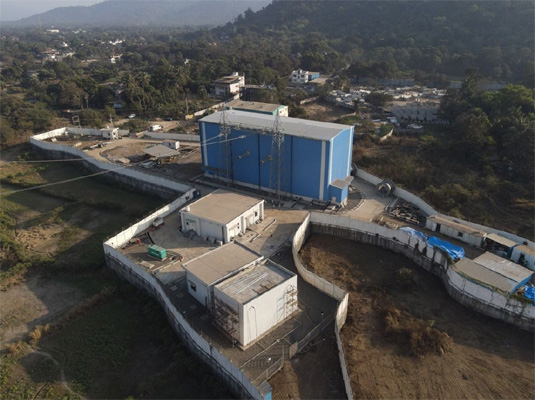
Kudus HVDC receiving station—the powerhouse node driving seamless, high-capacity renewable energy into the city. – NE photo
- 1,000 MW HVDC link boosts renewable energy flow into Mumbai and MMR
- Kudus–Aarey corridor enhances grid reliability, cuts outage risks post-2020 blackout lessons
- World’s first compact HVDC substation sets new benchmark for dense urban infrastructure
- Advanced VSC technology ensures precision, stability, and faster power restoration
- Project signals shift towards cleaner, resilient and future-ready urban energy systems
NE ENERGY BUREAU
MUMBAI, APR 14
In a major leap towards sustainable and resilient power infrastructure, Adani Energy Solutions Limited has commissioned a 1,000 megawatt (MW) high-voltage direct current (HVDC) transmission link, significantly enhancing the flow of renewable energy into Mumbai and the wider Mumbai Metropolitan Region (MMR).
Executed by Adani Electricity Mumbai Infrastructure Limited, the project connects Kudus and Aarey through a sophisticated network comprising a 30-km overhead line and a 50-km underground corridor—engineered to function seamlessly within the constraints of one of India’s most densely populated urban landscapes.
Conceived in the aftermath of the 2020 Mumbai blackout, the project addresses critical vulnerabilities in the city’s power grid, strengthening reliability and ensuring a more secure electricity supply.
At its core, the HVDC link enables Mumbai to draw higher volumes of electricity from outside the city, particularly renewable energy generated in distant regions. While already connected to the national grid, this enhanced corridor allows more controlled, efficient, and high-capacity power transmission—marking a shift in how energy is delivered to one of India’s most power-intensive urban clusters.
The additional 1,000 MW capacity reduces dependence on in-city generation, eases network congestion, and significantly lowers the risk of large-scale outages—offering a robust solution to rising urban energy demands.
A standout feature of the project is the deployment of advanced Voltage Source Converter (VSC)-based HVDC technology, which enables precise control of power flows, improved voltage stability, and enhanced grid performance in space-constrained environments. It also brings operational advantages such as reduced transmission losses, dynamic voltage support, and black-start capability—allowing faster restoration of power without external support during outages.
The project also introduces the world’s first compact HVDC substation, setting a new global benchmark for infrastructure innovation in dense cities.
Describing the milestone, Kandarp Patel, CEO, Adani Energy Solutions Ltd., said, “With the commissioning of the Aarey–Kudus transmission line, Mumbai now has a modern power corridor capable of integrating large-scale renewable energy with high reliability. It is one of the fastest HVDC project ever commissioned which is powered by advanced VSC-based HVDC technology. The project enhances grid stability, decongests existing networks and strengthens the city’s energy security. This marks a significant step towards a cleaner, more resilient energy future for Mumbai.”
As one of the largest urban HVDC infeeds globally, the Kudus–Aarey link underscores the growing importance of integrating long-distance clean energy into urban grids—paving the way for a greener and more sustainable future.