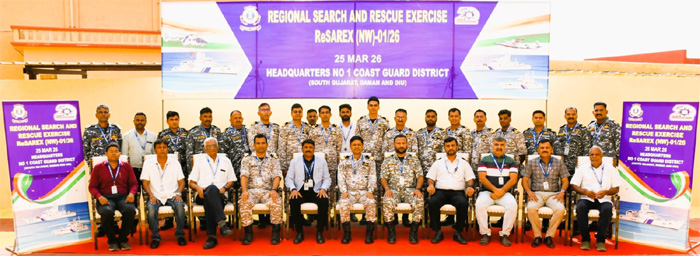
- Indian Coast Guard leads high-intensity SAR exercise to boost maritime emergency response
- Navy, aviation, port, fisheries and police agencies join forces in a unified operational grid
- Simulated aircraft ditching triggers complex mass rescue, firefighting and medical evacuation drill
- Drill reaffirms India’s capability to secure 4.6 million sq km Search & Rescue Region with precision
NE DEFENCE BUREAU
GANDHINAGAR, MAR 25
In a powerful display of preparedness at sea, the Indian Coast Guard conducted a large-scale Regional Search and Rescue Exercise (SAREX) off the Porbandar coast, reinforcing India’s maritime emergency response architecture and inter-agency coordination.
The exercise brought together a wide spectrum of maritime stakeholders—including the Indian Navy, Airports Authority of India, Gujarat Maritime Board, Marine Police, Vessel Traffic Services (VTS), Department of Fisheries and Coast Guard units—creating a synchronised operational ecosystem.
Simulating crisis: Aircraft ditching at sea
The drill revolved around a mass search and rescue (M-SAR) scenario, simulating an aircraft ditching at sea and demanding a swift, layered response.
The Maritime Rescue Sub Centre (MRSC), Porbandar functioned as the Incident Command Post, working in close coordination with the Maritime Rescue Coordination Centre Mumbai to ensure seamless communication and operational control.
Beyond rescue: Firefighting, medical & evacuation precision
Participating units performed dual roles as Search and Rescue Units (SRUs) and Medical Support Ships, deploying onboard medical teams for first aid and casualty evacuation.
Simultaneously, Coast Guard ships demonstrated firefighting capabilities near the simulated crash site, showcasing readiness to handle multi-dimensional emergencies in real time.
The exercise also included debris management and survivor grouping, reflecting a structured and methodical recovery protocol.
From sea to shore: Full-spectrum response
Following the at-sea phase, operations transitioned to harbour, where triage procedures were carried out with ambulance and medical support teams.
The orderly movement of vessels into harbour mirrored real-world emergency protocols, underlining end-to-end preparedness—from distress call to final medical response.
Guarding a vast maritime frontier
India’s Search and Rescue Region (SRR), spanning 4.6 million square kilometres, falls under the coordination of the Indian Coast Guard, making such exercises critical to operational readiness.
The Porbandar SAREX validated communication frameworks, inter-agency synergy and rapid response mechanisms, setting a benchmark for maritime safety drills along the Gujarat coast.