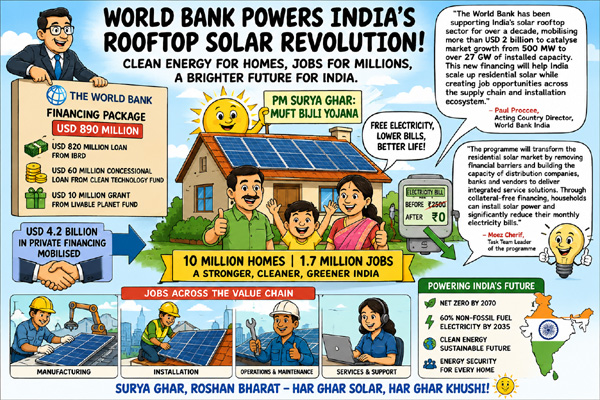
- Historic financing to supercharge PM Surya Ghar: Muft Bijli Yojana and accelerate India’s clean energy transition
- Multi-billion-dollar initiative to unlock affordable rooftop solar, slash household electricity bills and catalyse massive private investment
- Programme strengthens India’s journey towards Net Zero 2070 while boosting domestic manufacturing, skilled employment and energy security
- World Bank-backed initiative to empower distribution companies, financial institutions and vendors with integrated solar ecosystem support
- Residential solar sector poised for transformational growth as India emerges as a global clean energy powerhouse
NE ENERGY BUREAU
NEW DELHI, JULY 10
In a landmark endorsement of India’s clean energy ambitions, the World Bank’s Board of Executive Directors has approved a transformative US$890 million financing package to accelerate the country’s flagship rooftop solar programme, paving the way for 10 million households to embrace clean electricity while generating an estimated 1.7 million jobs across manufacturing, installation and renewable energy services.
The ambitious initiative is expected to become one of the world’s largest residential solar expansion programmes, reinforcing India’s commitment to achieving Net Zero emissions by 2070 and increasing the share of non-fossil fuel-based electricity to 60 per cent by 2035.
Despite remarkable progress in utility-scale solar generation, residential rooftop solar has remained an underutilised opportunity. To bridge this gap, the Government of India launched the PM Surya Ghar: Muft Bijli Yojana, designed to encourage rooftop solar installations in both rural and urban households, reduce electricity expenses and stimulate domestic manufacturing of solar equipment.
Backing this national mission, the World Bank’s latest financing package includes an US$820 million loan from the International Bank for Reconstruction and Development (IBRD), a US$60 million concessional loan from the Clean Technology Fund, and a US$10 million grant from the IBRD’s Livable Planet Fund.
The initiative is expected to unlock a much larger wave of investment, with the World Bank set to mobilise an additional US$4.2 billion in private financing through commercial lending institutions, enabling millions of households to install rooftop solar systems with greater ease.
Highlighting the significance of the programme, Paul Proccee, Acting Country Director, World Bank India, said the institution has consistently partnered with India in advancing renewable energy.
“The World Bank has been supporting India’s solar rooftop sector for over a decade, mobilising more than USD 2 billion to catalyse market growth from 500 MW to over 27 GW of installed capacity. This new financing will help India scale up residential solar while creating job opportunities across the supply chain and installation ecosystem.”
The programme is designed not only to increase clean energy adoption but also to strengthen the entire rooftop solar ecosystem by enhancing the capabilities of electricity distribution companies, financial institutions and technology vendors.
Explaining the programme’s broader impact, Moez Cherif, Task Team Leader of the programme, emphasised that improved financing mechanisms would make rooftop solar more accessible to ordinary households.
“The programme will transform the residential solar market by removing financial barriers and building the capacity of distribution companies, banks and vendors to deliver integrated service solutions. Through collateral-free financing, households can install solar power and significantly reduce their monthly electricity bills.”
Industry observers believe the initiative will significantly accelerate India’s renewable energy transition by expanding clean electricity access, lowering dependence on conventional energy sources, reducing carbon emissions and creating sustainable livelihoods across the green economy.
Beyond supporting household energy security, the programme is expected to stimulate domestic manufacturing, encourage technological innovation, strengthen supply chains and reinforce India’s emergence as a global leader in sustainable and climate-resilient energy solutions.
As the country continues its rapid clean energy transformation, the World Bank’s latest commitment is poised to become a defining milestone in building an affordable, inclusive and environmentally sustainable energy future for millions of Indian families.