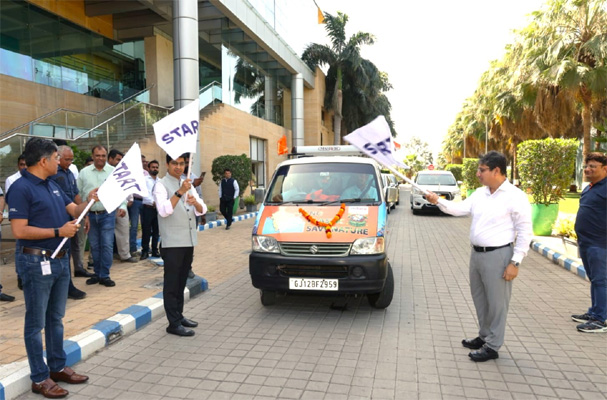

Four philanthropists from Mundra — Kapil Gor, Harinath Nathbawa, Mukundnath Nathbawa and Savangiri Goswami — embark on the spiritual yatra across India and Nepal — NE photo
- Adani Ports launches India–Nepal spiritual odyssey from Kutch coast
- Pilgrimage to cover 12 Jyotirlingas, 4 Dhams and Pashupatinath
- “No Plastic – Save Nature” message drives eco-conscious devotion
- Four Mundra philanthropists lead yatra blending faith, service and sustainability
NE SPIRITUAL BUREAU
MUNDRA, MAR 29
A unique spiritual odyssey carrying the twin messages of devotion and environmental responsibility was flagged off from Adani Ports and SEZ, Mundra, marking the beginning of a grand Shrimad Bhagwat Mahayatra across India and Nepal.
The pilgrimage, inaugurated by Mundra Customs Commissioner Nitin Saini, aims to traverse the sacred circuit of the 12 Jyotirlingas, the four Dhams, and the revered Pashupatinath Mahadev Temple in Nepal, before returning to its starting point in Mundra.
Senior officials including Rakshit Shah, Executive Director, Adani Ports, and Sujal Shah, CEO, Adani Mundra-Tuna Port, were present at the ceremonial launch.
Undertaken by four dedicated philanthropists from Kutch — Kapil Gor, Harinath Nathbawa, Mukundnath Nathbawa, and Savangiri Goswami — the yatra reflects a collective spirit of devotion, unity, and social commitment.
The initiative draws inspiration from the recently organised Shrimad Bhagwat Katha, where over one lakh devotees participated in a completely plastic-free event. Reinforcing the same ethos, the ongoing yatra carries a strong environmental message: “No Plastic – Save Nature.”
Throughout the journey, the pilgrims will promote reduced plastic usage, cleanliness, and sustainable practices, turning the spiritual expedition into a nationwide awareness movement.
Highlighting the philosophy behind the initiative, organisers emphasised that the effort goes beyond ritualistic travel to embody a deeper purpose — “a blend of spirituality, culture, and environmental stewardship that can inspire society at large.”
The earlier katha set a benchmark in eco-conscious devotion, using traditional steel utensils for prasad and buttermilk, and earthen pots for water, aligning with the “Vocal for Local” ethos and earning widespread appreciation across Kutch.
With this Mahayatra, the Adani Group extends that message beyond regional boundaries, seeking to create a ripple effect across India and Nepal — where faith becomes a vehicle for sustainability.
As the yatra embarks on its expansive route, it stands as a symbolic journey — not just across sacred geographies, but towards a more conscious and responsible way of living.