- Advanced Weapon System Complex inaugurated at DRDO’s Defence Research & Development Laboratory in Hyderabad to accelerate indigenous missile and strategic weapons development
- Defence Minister says the stellar performance of home-grown missile systems during Operation Sindoor validates the growing strength of India’s defence research and innovation ecosystem
- ‘Mission Sudarshan Chakra’ envisioned as a three-layered national missile shield to safeguard military assets, critical infrastructure and civilian establishments against aerial threats
- Calls for faster transition from laboratory innovation to mass production as artificial intelligence, hypersonic weapons and autonomous systems redefine modern warfare
- Emphasises resilience, deterrence and self-reliance as the three strategic pillars shaping India’s future defence preparedness in an increasingly uncertain global security environment
NE DEFENCE BUREAU
HYDERABAD, JUNE 12
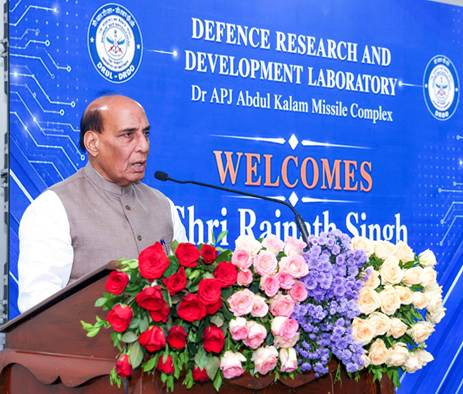
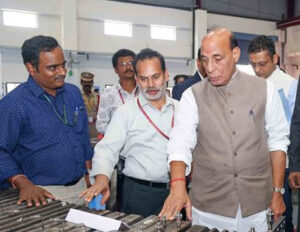
In a major boost to India’s indigenous defence capabilities, Defence Minister Rajnath Singh on Friday inaugurated the Advanced Weapon System Complex at the Defence Research & Development Laboratory (DRDL), part of the Dr APJ Abdul Kalam Missile Complex in Hyderabad, declaring that the remarkable success of indigenous missile systems during Operation Sindoor reflects the growing maturity and strength of the country’s defence research ecosystem.
Addressing scientists and defence personnel, the Defence Minister said India’s home-grown missile platforms have demonstrated that the nation now possesses world-class technological capabilities capable of competing with the best defence systems globally.
“The systems developed by DRDO, such as Akash and BrahMos, proved that India possesses the capability to compete in the global defence technology ecosystem. Strength is essential for peace, and self-reliance is the most reliable foundation for that strength. It is a fact proven by DRDO.”
Highlighting the decisive role played by India’s air defence architecture during Operation Sindoor, he said the country’s defensive capabilities successfully neutralised hostile aerial threats.
“When aerial threats loomed over our borders, our air defence system completely thwarted the enemy’s intentions.”
Building on that experience, the Defence Minister reiterated the government’s commitment to developing “Mission Sudarshan Chakra,” a comprehensive multi-layered missile defence architecture announced by Prime Minister Narendra Modi during the 2025 Independence Day address.
“‘Mission Sudarshan Chakra’, announced by PM Modi during his 2025 Independence Day address, is set to become a multi-level missile defence system of modern India. It will not only protect military installations and critical infrastructure, but also ensure the safety of civil infrastructure and key establishments. The system will possess the capability to deliver a decisive punch whenever needed. Its three-layered protection will ensure minimal inconvenience to citizens and prioritise their safety. It is a system designed to provide a robust protective shield for all assets of vital importance.”
Modern Warfare Demands Resilience and Deterrence
The Defence Minister observed that rapid advances in technology are fundamentally transforming the character of warfare, making preparedness and technological superiority indispensable.
“Precision-strike capabilities, integrated air defence systems, hypersonic weapons, autonomous platforms, artificial intelligence, electronic warfare and advanced sensor technologies are redefining the nature of modern warfare. The international order is undergoing a period of tension and transformation, where old assumptions are crumbling and new alliances and challenges are taking shape. In such an environment, there is a need to possess ‘resilience’ — the capacity to absorb any shock and bounce back — and ‘deterrence’ — the ability to instill fear in the mind of the aggressor that a befitting reply would be given if a hostile eye is cast.”
He said DRDO has emerged as a key institution in strengthening both these capabilities.
“Today’s inauguration is a symbol of our resolve to become alert, capable and self-reliant in tackling every challenge.”
Innovation Must Lead to Production at Speed
Commending DRDO for simultaneously addressing present-day operational needs and investing in futuristic technologies, the Defence Minister said innovation must ultimately translate into rapid induction for the armed forces.
“DRDO’s responsibility is not limited to merely adapting to technological changes, but also anticipating future needs. It has accepted this challenge with confidence. In recent years, it has achieved numerous milestones in the field of indigenous missile technologies. Advanced missile systems have been successfully tested, and continuous progress is being made in strategic and tactical weapon programmes. These achievements are not just technological milestones; they also demonstrate India’s growing self-reliance, self-confidence and strategic capabilities.”
Calling for closer collaboration among DRDO, the armed forces and industry, he stressed that technological superiority alone cannot guarantee victory unless backed by large-scale production capabilities.
He urged the defence ecosystem to reduce development-to-production timelines, simplify manufacturing processes, increase indigenous content and ensure that advanced weapon systems can be mass-produced quickly whenever national security demands.
The Defence Minister also highlighted the transformation of India’s defence innovation ecosystem through stronger collaboration among DRDO laboratories, defence public sector undertakings, private industry, start-ups, MSMEs and academia.
Expressing confidence in the country’s defence research establishment, he said this collaborative model would accelerate India’s journey from innovation to production and from production to operational capability, significantly enhancing the combat readiness of the armed forces.
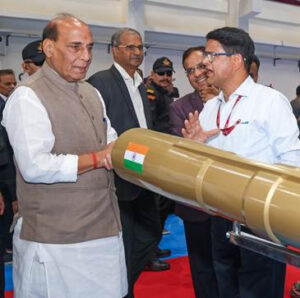
Following the inauguration, the Defence Minister visited a technical exhibition showcasing DRDO’s latest indigenous missile platforms, advanced weapon systems and cutting-edge defence technologies that are shaping the future of India’s strategic capabilities.