R ARIVANANTHAM
CHENNAI, SEPT 12
For Indian investors, it is Diwali every day. And now, there is an opportunity to own a slice of the very marketplace where much of that wealth creation happens. The much-awaited ₹22,569-crore IPO of the National Stock Exchange of India Ltd is set to turn the spotlight on the exchange itself, with investors preparing to discover what the market believes India’s most dominant stock exchange is actually worth.
The irony is irresistible: the institution that has helped India discover the price of millions of securities is now placing its own price before the market.
- Now, the market-maker itself comes to market: ₹22,569-crore NSE IPO opens September 17
- NSE has spent three decades creating wealth opportunities for Indian investors—now investors get a chance to own a piece of NSE itself
- ₹1,700–₹1,785 price band puts a public valuation on India’s market giant
- IPO is for price discovery, not fresh capital, says NSE
- 92.99% cash-market share and 132.37 million unique investors underline dominance
- ₹10,302-crore FY26 profit strengthens the investment case
- AI surveillance and Electronic Gold Receipts could power the next phase
- September 24 listing could mark a new chapter for India’s capital markets
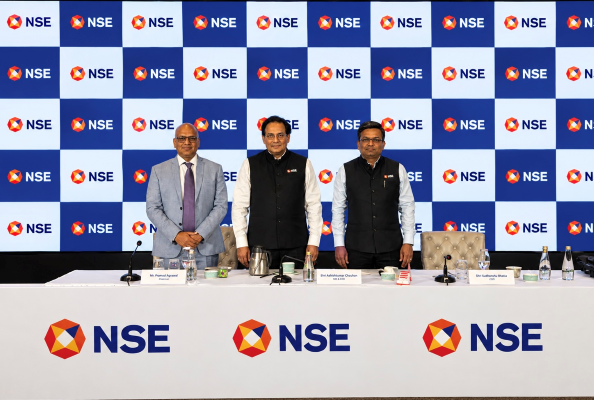
“The NSE is coming to IPO markets for price discovery and does not need further capital as such,” Sriram Krishnan, Chief Business Development Officer, NSE Ltd, said at a media interaction here on Saturday.
That makes the NSE issue fundamentally different from a conventional fund-raising IPO. The entire issue is an offer for sale, with existing shareholders monetising up to 12,64,36,650 shares. The company itself will not receive the IPO proceeds.
For prospective investors, therefore, the question is not whether NSE needs their money.
The question is: what is India’s financial-market powerhouse worth?
A market giant seeking its own market price
NSE has fixed the price band at ₹1,700–₹1,785 a share. The issue opens on September 17 and closes on September 21.
At the upper end, the offer is expected to raise around ₹22,568 crore, implying a market capitalisation of approximately ₹4.42 lakh crore.
The scale of the underlying business is equally striking.
NSE commanded 92.99% of India’s cash-market turnover in fiscal 2026, while its equity-futures market share stood at 99.79%, according to the Redseer Report cited in the company’s offer documents.
Its unique registered investor base has grown from 30.87 million in March 2020 to 132.37 million by June 2026, a CAGR of 26.23%.
In simple investor language: NSE isn’t merely participating in India’s capital-market growth—it is sitting at its centre.
Where old money meets new investors
The IPO also opens an extraordinary wealth-creation chapter for several long-standing shareholders.
The reported weighted average acquisition cost of shares held by New India Assurance, Oriental Insurance and National Insurance is only ₹0.32 per share. Their combined proposed sale could fetch around ₹2,370 crore at the upper IPO band.
Several other early institutional shareholders also stand to realise returns running into thousands of times their reported acquisition costs.
But the NSE IPO comes with its own reminder about market risk: an individual shareholder, Mahesh Gupta, whose reported acquisition cost is ₹1,826.85 a share, would be selling below that cost at the IPO’s upper band.
The lesson for today’s investor is clear: spectacular historical gains belong to the past; the IPO price will create a new starting point for public-market investors.
₹10,302 crore profit engine
The numbers behind NSE’s valuation are formidable.
For fiscal 2026, NSE reported ₹10,302.06 crore in net profit on total income of ₹18,713.37 crore.
In the June 2026 quarter, revenue from operations rose to ₹4,560 crore, from ₹4,032 crore a year earlier, while net profit climbed to ₹3,121 crore from ₹2,811 crore.
The exchange facilitated total fund mobilisation of ₹20.33 trillion during fiscal 2026.
For investors, the proposition is therefore not simply ownership of a stock exchange. It is exposure to a deeply entrenched piece of India’s financial infrastructure.
The technology behind the wealth machine
The real moat may lie beneath the numbers—in technology.
NSE’s platform processed an average 12.46 billion messages every day between April 2024 and June 2026 and can process nearly 5 million messages per second, with microsecond response times.
On March 24, 2026, it processed 201 million trades in a single day.
As India’s investor base expands and trading becomes increasingly technology-driven, the exchange’s scale, reliability and liquidity could remain critical competitive advantages.
AI watches the market
NSE is also deploying artificial intelligence in surveillance to identify behavioural patterns and help prevent manipulation.
Krishnan said the exchange has been using the technology for the past two-three years.
“With help of AI, we are able to prevent manipulation and any such instances. This is an evolving process,” he said.
Gold could be the next big opportunity
NSE is not stopping at equities.
The exchange plans to introduce Electronic Gold Receipts (EGR) in the coming months, a move that could help create a formal spot market for gold in India.
For investors, this points to a broader strategy: use NSE’s technology, liquidity and market infrastructure to expand into new financial-market opportunities.
The big question on September 24
The proposed September 24 listing on BSE will provide the first real public-market verdict on NSE’s valuation.
Until then, investors will weigh its extraordinary market share, profitability, technology infrastructure, expanding investor base and future opportunities against the price at which the shares are being offered.
India’s market-maker is finally entering the market itself
And if the NSE IPO succeeds in translating its extraordinary operating dominance into an equally compelling public valuation, the exchange that made wealth creation a daily ritual for millions of Indians could itself become one of the market’s biggest Diwali stories.