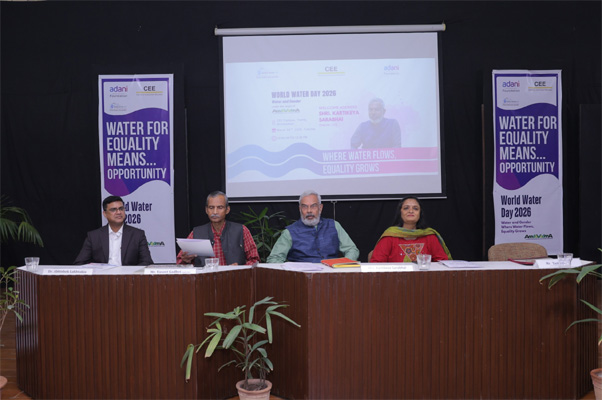
- From crisis to collective conscience: Multi-stakeholder dialogue flags water as India’s defining development challenge
- Women at the frontline: Gender equity emerges as the missing link in water governance
- Beyond policy paralysis: Community ownership pitched as the real game-changer
- Scaling hope: 16.28 billion litres of added capacity signals replicable grassroots success
NE ENVIRONMENT BUREAU
AHMEDABAD, MAR 24
In a stark reminder that India’s water crisis is no longer a distant threat but a lived reality, the Adani Foundation, in collaboration with the Centre for Environment Education, convened a high-impact dialogue on water security—placing community stewardship and gender equity at the heart of the solution.
Held at the CEE campus in Ahmedabad to mark World Water Day 2026, the meet brought together policymakers, industry leaders, CSR heads and grassroots practitioners to confront the widening gap between water demand and sustainable access.
At the centre of deliberations was a compelling message: India cannot solve its water crisis through policy frameworks alone—it must ignite a people-led movement.
“Water will remain one of the defining challenges of our time. We must move beyond the illusion of abundance,” said Kartikeya Sarabhai, Director, CEE.
“The burden of scarcity falls disproportionately on rural women. A Viksit Bharat must begin with valuing every drop—by blending traditional wisdom with youth-led action.”
Echoing this urgency, Vasant Gadhavi, Chief Guest at the event, stressed the limits of top-down governance.
“Water security cannot be addressed through policy alone. It must be driven by communities,” he said.
“Groundwater depletion and climate variability demand immediate action. Our focus is to enable local ownership so conservation becomes a sustained collective movement.”
Aligned with the United Nations’ 2026 theme—“Water and Gender”—the dialogue spotlighted the deep intersection between water access and social equity, especially in rural India where women bear the brunt of scarcity.
With India supporting nearly one-fifth of the global population on constrained freshwater resources, participants underscored that water security is intrinsically tied to livelihoods, agriculture and long-term economic resilience.
The Adani Foundation showcased its expanding footprint in water-stressed regions, revealing that over 16.28 billion litres of additional water storage capacity has been created through community-driven initiatives. These efforts span arid and semi-arid geographies, including Kutch in Gujarat, parts of Rajasthan and Vidarbha in Maharashtra—focusing on watershed development, rainwater harvesting and decentralised governance.
Technical sessions delved into urban water stress, WASH (Water, Sanitation and Hygiene) interventions and scalable community governance models, while a panel discussion highlighted the urgent need for synergy between government, industry and civil society.
Among the key participants were Abhishek Lakhtakia and Vinay Kumar Jain, who emphasised innovation and partnerships as critical levers for change.
The dialogue concluded with a powerful call to action: India’s water future hinges not just on infrastructure, but on inclusion, innovation and collective responsibility.